ADHD is highly heritable, but through thousands of common variants of tiny effect plus rarer variants in some families. Genes describe risk in populations, not a diagnosis in a person.
1 · Quick understanding
ADHD runs in families. Most of that is genetic, but not in the "one faulty gene" sense. It is closer to height: many variants, each nudging the odds slightly.
Family, twin and adoption studies show ADHD runs in families, with twin heritability around 74%; about a third of heritability is attributed to many common variants of small effect, and rare copy-number variants account for part of the rest.
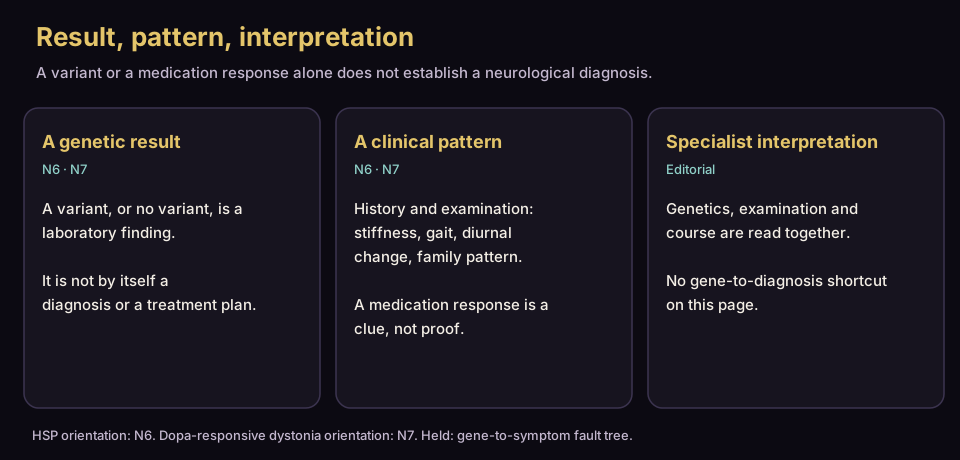
A variant or medication response alone does not establish a neurological diagnosis.Read diagram text
A genetic result is a laboratory finding (orientation N6, N7).
A clinical pattern comes from history and examination. A medication response is a clue, not proof.
Specialist interpretation reads them together.
A variant or a medication response alone does not establish a neurological diagnosis. The album gene-to-symptom fault tree is held.
2 · Possible explanations
The 2023 genome-wide meta-analysis identified 27 loci, implicated 76 genes enriched in early brain development, found a higher burden of rare protein-truncating variants in a set of risk genes (implicating SORCS3), and linked common-variant risk to weaker complex cognition and executive function.
What this means: genetic risk shapes how the brain develops and runs, mostly through many small effects. What it does not mean: that a genetic test can confirm ADHD, or that any one gene explains a person's symptoms.
5 · Deeper explanation
The overlap with other conditions is large. That supports the idea that some of the same developmental machinery underlies several conditions, with different combinations producing different presentations — consistent with frequent co-occurrence.
Individual genetic findings in single people (for example, a variant found on a panel test) need specialist interpretation; most variants are of uncertain significance.
Sources cited
R7 Faraone SV, Larsson H. Genetics of attention deficit hyperactivity disorder. Molecular Psychiatry 2019;24(4):562–575. (Abstract read (PubMed))
N6 NHS Genomics Education — Hereditary spastic paraplegia link(Webpage read; not an independent systematic review)
N7 MedlinePlus Genetics — Dopa-responsive dystonia link(Webpage read; not an independent systematic review)
W5 Demontis D, et al. Genome-wide analyses of ADHD identify 27 risk loci, refine the genetic architecture and implicate several cognitive domains. Nature Genetics 2023;55:198–208. 38,691 cases, 186,843 controls. (Abstract read (PubMed))