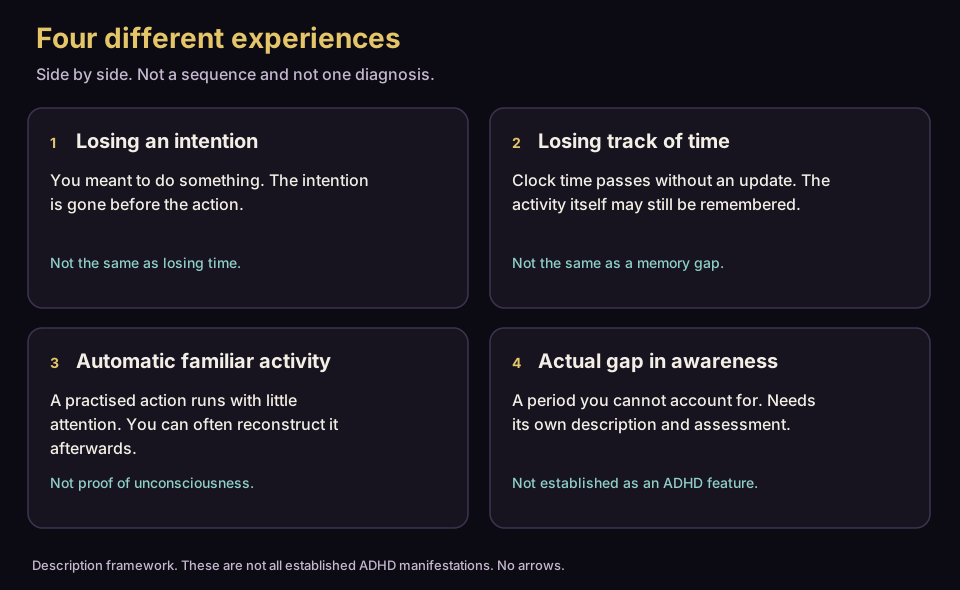
Forgetting what you meant to do, losing track of time and acting on autopilot are different problems with different clues.
1 · Quick understanding
"Forgetting" covers at least four different things: losing an intention between deciding and doing, losing track of elapsed time, doing something automatically without noticing, and not registering something at all. They feel similar in the moment, but they point to different explanations and different help.
Difficulties with holding goals, managing time and inhibiting distractions are among the best-documented features of ADHD across large studies.
Pain and physical effort may consume the same limited control capacity, so cognitive slips worsen on bad physical days. This is a plausible link to test in your own records, not an established finding.
3 · Useful next action
Keep a short log for one week. For each slip, write what you meant to do, when you lost it, what you were doing instead, and what else was true (sleep, pain, medicines, stress). Then bring three examples to an appointment using the appointment sheet.
5 · Deeper explanation
Goals have to be kept "live" while competing inputs arrive. In network terms, the prefrontal cortex biases other regions towards the task that matters; when that bias is weak, the most salient input wins. Medicines that raise prefrontal dopamine and noradrenaline tend to strengthen that bias — see How ADHD medicines act.
Group-level research describes averages. Any one person's slips may have several causes at once, including ones unrelated to ADHD.
Unresolved sources
A dedicated review of time-perception research has not yet been added to the source register.
Sources cited
W6 Faraone SV, et al. The World Federation of ADHD International Consensus Statement: 208 evidence-based conclusions about the disorder. Neuroscience & Biobehavioral Reviews 2021;128:789–818. link(Abstract read; full text open access)
R9 Arnsten AFT. Toward a new understanding of ADHD pathophysiology: an important role for prefrontal cortex dysfunction. CNS Drugs 2009;23 Suppl 1:33–41. (Abstract read (PubMed))