Reviewed proposal · not approved
VMAT2 and two different proton gradients
Distinguish the proton gradient across a vesicle membrane from the gradient across a mitochondrial membrane.
Sources are attached to the gradient and ATP sentences. The diagram is an original schematic, not a published figure and not science approval. Still off Home and unapproved.
Prints the text and captions. Diagrams are not embedded, and the file is not a tagged PDF.
The gradient across the vesicle. Step 1 of 2
The gradient across the vesicle
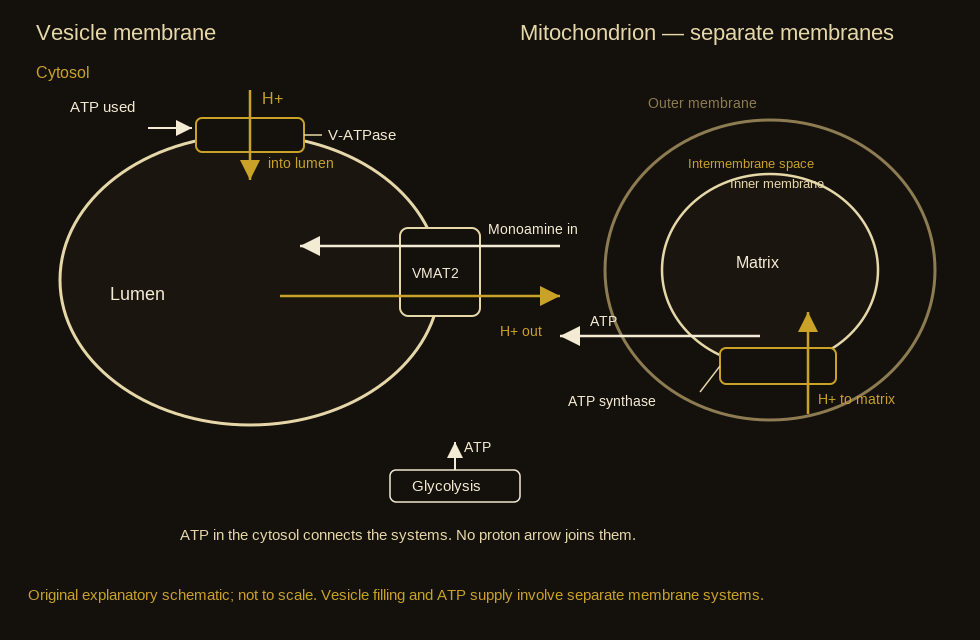
VMAT2 moves dopamine into a vesicle using a proton gradient that the vesicle's own pump (a V-ATPase, which uses ATP) builds across its membrane. It is not driven directly by the mitochondrial proton gradient.
Tier A on the page is not a source. These two sentences are shown together so the distinction is not delayed. The sources are transporter experiments, not a demonstration of one person's ADHD.
Text explanation with captions. Diagrams are not embedded. This printout is not a tagged PDF.
Reviewed proposal · not approved · rx-2026-11-06.stage1.2
VMAT2 and two different proton gradients
Distinguish the proton gradient across a vesicle membrane from the gradient across a mitochondrial membrane.
Full article: /science/genetics/gen-03/
Step 1 of 2. The gradient across the vesicle
VMAT2 moves dopamine into a vesicle using a proton gradient that the vesicle's own pump (a V-ATPase, which uses ATP) builds across its membrane. It is not driven directly by the mitochondrial proton gradient.
Tier A on the page is not a source. These two sentences are shown together so the distinction is not delayed. The sources are transporter experiments, not a demonstration of one person's ADHD.
Figure: Original explanatory schematic; not to scale. Vesicle filling and ATP supply involve separate membrane systems.
Sources
- Ye et al. (2025), Molecular basis of vesicular monoamine transport and neurological drug interactions. DOI 10.1016/j.celrep.2025.116490. PMID 41166311 — laboratory mechanistic experiments — https://pmc.ncbi.nlm.nih.gov/articles/PMC12721464/
- Neurotransmitter recognition by human vesicular monoamine transporter 2 (2024). DOI 10.1038/s41467-024-51960-z — laboratory mechanistic experiments — https://www.nature.com/articles/s41467-024-51960-z
Step 2 of 2. Where mitochondria fit
The vesicle pump uses ATP. Mitochondria help supply ATP, and glycolysis can supply it too. The mitochondrial and vesicle proton gradients are across separate membranes.
ATP availability is the energy connection. It is not a proton pipe between the organelles, and vesicular ATP need not all come from the adjacent mitochondrion.
Sources
- Rangaraju, Calloway and Ryan (2014). DOI 10.1016/j.cell.2013.12.042. PMID 24529383 — laboratory mechanistic experiments — https://pmc.ncbi.nlm.nih.gov/articles/PMC3955179/
- Ye et al. (2025), for the vesicle side of the separation. DOI 10.1016/j.celrep.2025.116490 — laboratory mechanistic experiments — https://pmc.ncbi.nlm.nih.gov/articles/PMC12721464/