Published excerpt
What is ADHD?
ADHD is a recognised neurodevelopmental condition described by persistent patterns of inattention and/or hyperactivity and impulsivity with functional impact.
Prints the text and captions. Diagrams are not embedded, and the file is not a tagged PDF.
What ADHD means. Step 1 of 4
Explanation
What ADHD means
ADHD is a recognised neurodevelopmental condition described by persistent patterns of inattention and/or hyperactivity and impulsivity with functional impact. The outward pattern can differ across people, settings and life stages.
A diagnosis requires a structured assessment; a single behaviour, questionnaire score or gene result does not establish it.
Text explanation with captions. Diagrams are not embedded. This printout is not a tagged PDF.
Published excerpt · rx-2026-11-06.stage1.2
What is ADHD?
ADHD is a recognised neurodevelopmental condition described by persistent patterns of inattention and/or hyperactivity and impulsivity with functional impact.
Full article: /science/what-is-adhd/
Step 1 of 4. What ADHD means
ADHD is a recognised neurodevelopmental condition described by persistent patterns of inattention and/or hyperactivity and impulsivity with functional impact. The outward pattern can differ across people, settings and life stages.
A diagnosis requires a structured assessment; a single behaviour, questionnaire score or gene result does not establish it.
Figure: MJB ADHD Process Atlas · Whole system overview · an organising model, not one ADHD formula or a diagnostic graph
Sources
- What is ADHD? (MJB ADHD article) — https://mjb-adhd.org.uk/science/what-is-adhd/
- WHO ICD-11 clinical descriptions, 2024 — https://www.who.int/publications/i/item/9789240077263
- NICE NG87, current recommendations — https://www.nice.org.uk/guidance/ng87/chapter/recommendations
Step 2 of 4. Attention is only part of it
“A quiet or high-performing person cannot have ADHD.” A visible result cannot, on its own, explain the process behind it. Look for the sustained cost of functioning across settings, including compensatory effort.
Sources
- What is ADHD? (MJB ADHD article) — https://mjb-adhd.org.uk/science/what-is-adhd/
Step 3 of 4. Whole system overview
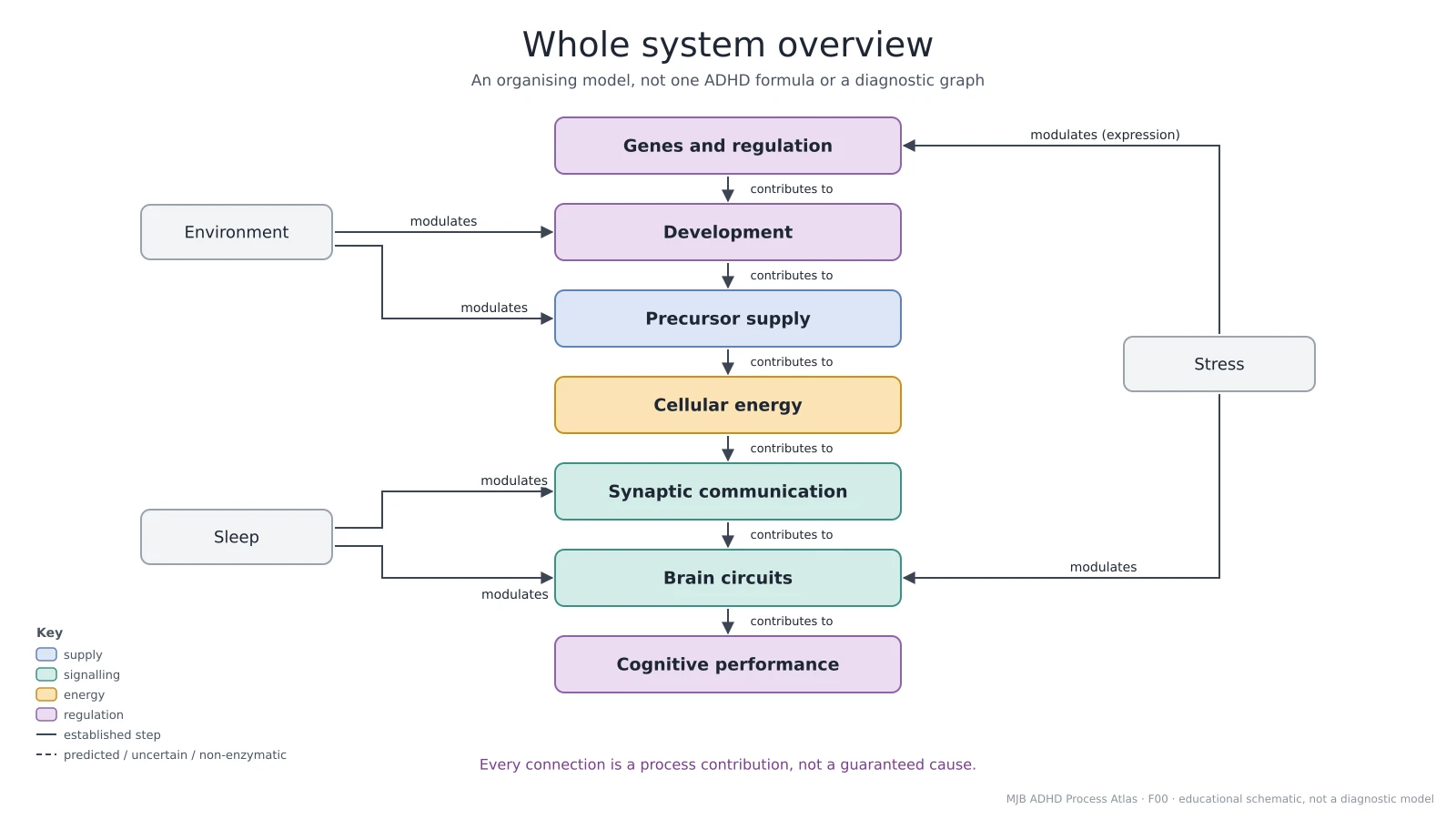
Read from genes and regulation through development, precursor supply, cellular energy, synaptic communication and brain circuits to cognitive performance. Sleep, stress and environment are additional inputs.
The connecting arrows organise relationships for learning; they do not demonstrate one causal chain, one defect shared by everybody with ADHD or a diagnostic test.
Figure: MJB ADHD Process Atlas · Whole system overview · an organising model, not one ADHD formula or a diagnostic graph
Sources
- What is ADHD? (MJB ADHD article) — https://mjb-adhd.org.uk/science/what-is-adhd/
- Demontis and colleagues 2023 ADHD GWAS (Nature Genetics) — https://doi.org/10.1038/s41588-022-01285-8
Step 4 of 4. What genes can and cannot tell you
There is no single “ADHD gene”. The picture is thousands of common variants that each nudge risk a tiny amount, plus rarer variants with bigger effects, plus chance and environment (Tier B). Genes describe risk. They are not a diagnostic test and they do not tell a clinician which medication to use (Tier B).
Sources
- What is ADHD? (MJB ADHD article) — https://mjb-adhd.org.uk/science/what-is-adhd/