Published excerpt
Genetics and ADHD: start here
"It's genetic" gets heard as "one faulty gene". The real finding is closer to "many small dials and a few large switches".
Prints the text and captions. Diagrams are not embedded, and the file is not a tagged PDF.
What needs distinguishing. Step 1 of 4
Explanation
What needs distinguishing
"It's genetic" gets heard as "one faulty gene". The real finding is closer to "many small dials and a few large switches". Keeping those two pictures apart is the whole point of this series.
Text explanation with captions. Diagrams are not embedded. This printout is not a tagged PDF.
Published excerpt · rx-2026-11-06.stage1.2
Genetics and ADHD: start here
"It's genetic" gets heard as "one faulty gene". The real finding is closer to "many small dials and a few large switches".
Full article: /science/genetics/
Step 1 of 4. What needs distinguishing
"It's genetic" gets heard as "one faulty gene". The real finding is closer to "many small dials and a few large switches". Keeping those two pictures apart is the whole point of this series.
Figure: Schematic, not a data chart · Two studies, two counts
Sources
- Genetics and ADHD: start here (MJB ADHD article) — https://mjb-adhd.org.uk/science/genetics/
Step 2 of 4. No single "ADHD gene"
There is no single "ADHD gene". The picture is thousands of common variants that each nudge risk a tiny amount, plus rarer variants with bigger effects, plus chance and environment (Tier B). Genes describe risk. They are not a diagnostic test and they do not tell a clinician which medication to use (Tier B).
Sources
- Genetics and ADHD: start here (MJB ADHD article) — https://mjb-adhd.org.uk/science/genetics/
Step 3 of 4. ADHD runs in families
ADHD runs in families. Twin studies put heritability at about 74% (Tier B).
Population findings describe groups; they do not predict one person.
Sources
- Genetics and ADHD: start here (MJB ADHD article) — https://mjb-adhd.org.uk/science/genetics/
Step 4 of 4. Two studies, two counts
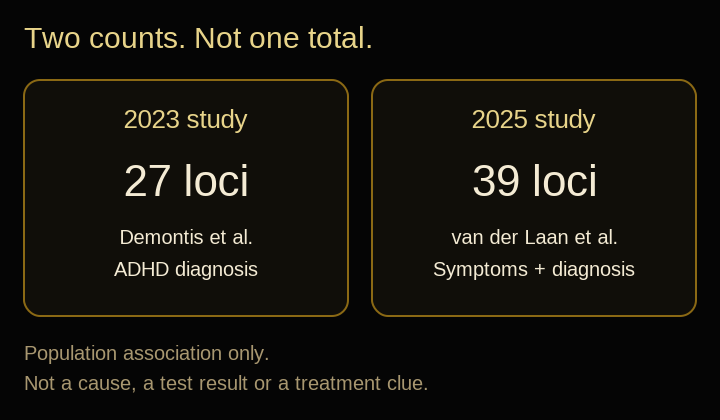
Demontis and colleagues (2023) reported 27 genome-wide significant regions from ADHD diagnosis data van der Laan and colleagues (2025) combined childhood symptom scores with diagnosis data and reported 39, of which 17 were new
The designs differ, so the counts are not a running total, and neither is a personal score.
Figure: Schematic, not a data chart · Two studies, two counts
Sources
- Genetics and ADHD: start here (MJB ADHD article) — https://mjb-adhd.org.uk/science/genetics/
- Demontis and colleagues 2023 ADHD GWAS (Nature Genetics) — https://doi.org/10.1038/s41588-022-01285-8
- van der Laan and colleagues 2025 childhood ADHD symptoms and diagnosis GWAS (Nature Genetics) — https://doi.org/10.1038/s41588-025-02295-y