A gap in a treatment that was working can quickly undo its benefit. Here is what the evidence does and does not show, and how to plan for continuity.
1 · Quick understanding
When an ADHD medicine that was helping stops, symptoms can return quickly. In the selected adult responders studied below, most relapses after switching to placebo occurred within two weeks. A planned break, agreed with a clinician and reviewed, is different from an unplanned gap caused by a broken pathway. The aim of this page is to help you get a timely, reasoned decision either way.
In a randomised withdrawal trial of adults stable on lisdexamfetamine for at least six months, 75% of those switched to placebo relapsed within six weeks, compared with 8.9% who continued — most relapses happened in the first two weeks.
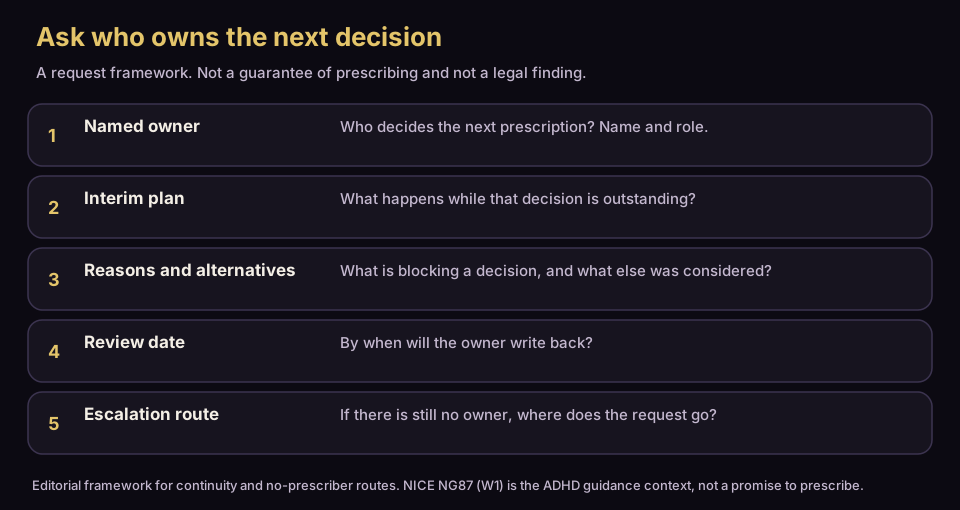
A request framework, not a guarantee of prescribing or a legal determination.Read diagram text
Ask, in writing: named owner; interim plan; reasons and alternatives; review date; escalation route if there is still no owner.
Not a guarantee of prescribing. Not a legal determination. Editorial framework for the continuity and no-prescriber routes. W1 is ADHD guidance context only and does not specify this five-box form.
2 · Possible explanations
Why does benefit fade so fast? Stimulants act within hours and are cleared within hours; they do not "build up" a lasting store of benefit. So stopping removes the effect on the next day's symptoms, not months later.
Why might harms follow? Large registry studies show that people with ADHD who start medication have lower rates of several serious outcomes than similar people who do not start. Those studies are about starting, not stopping — but they explain why clinicians and patients take unmet need seriously.
Among 148,578 people in Sweden newly diagnosed with ADHD, starting medication within three months was associated with lower two-year all-cause mortality (39.1 vs 48.1 per 10, 000; HR 0.79), driven by unnatural causes such as injuries, poisoning and suicide.
In a matching analysis, starting treatment was associated with fewer first episodes of suicidal behaviour (IRR 0.83), substance misuse, transport accidents and criminality — but not accidental injuries — with larger reductions in people who had had previous events.
In UK primary-care records, adults with diagnosed ADHD had an apparent life-expectancy gap of about 6.8 years (men) and 8.6 years (women) compared with matched controls.
Before or during any gap, get these five answers in writing. The next page has a request you can build and copy.
NICE asks that medication review include the effects of missed doses, planned dose reductions and periods of no treatment, and that the reasons for continuing are documented.
A restart after a gap is a clinical decision, not an administrative one. It should weigh the documented previous benefit, the reasons the gap happened, current physical and mental health, and the safest way to re-establish the dose. See Restarting after a gap.
In one case, a trust declined a "bridging" prescription on the grounds that restarting at the previous dose after several weeks off, outside an active treatment plan, would not be safe without a new assessment and titration plan.
That reasoning is common and can be legitimate. The question it leaves is timing: if reassessment is required, who provides it, and how soon?
5 · Deeper explanation
Interruption has several common causes in the UK, none controlled by the patient: national supply shortages; GP practices declining shared care (which places responsibility back with the specialist); discharge without a receiving prescriber; prescription lengths that do not match re-order rules; and substitution between products. Each produces a gap through a different broken link — and each needs a different fix.
Ministers have said GP practices may decline shared care, with responsibility then remaining with the specialist service.
If a gap has happened, what is the earliest date someone will make a prescribing decision?
What made the treatment work before, in specific, recordable terms?
Uncertainty
The sources assembled here do not establish the long-term harm of forced interruption of an established ADHD treatment in adults. The size of any risk for a particular person cannot be calculated from these studies.
Unresolved sources
Within-individual Swedish analyses of on- and off-treatment periods and UK shortage surveys are cited in earlier drafts but not yet re-checked for this register.
Sources cited
R1 Brams M, et al. Maintenance of efficacy of lisdexamfetamine dimesylate in adults with ADHD: randomized withdrawal design. J Clin Psychiatry 2012;73(7):977–83. Adults on lisdexamfetamine ≥6 months randomised to continue or switch to placebo for 6 weeks; n=116. (Abstract read (PubMed))
W1 NICE. Attention deficit hyperactivity disorder: diagnosis and management (NG87). 2018, updated 2019. Recommendations 1.7.11–1.7.14 (adult medication choice) and section 1.10 (review and discontinuation). link(Official text via search snippets and NHS shared-care documents quoting it; main page fetch blocked)
W2 Li L, Zhu N, Zhang L, et al. ADHD pharmacotherapy and mortality in individuals with ADHD. JAMA 2024;331(10):850–860. Sweden, n=148,578, ages 6–64. link(Abstract and key results read (PubMed); full text open access)
W3 Zhang L, et al. ADHD drug treatment and risk of suicidal behaviours, substance misuse, accidental injuries, transport accidents, and criminality: emulation of target trials. BMJ 2025;390:e083658. Sweden, n=148,581. A correction to figure 2 labels was published (PMC12401081). link(Abstract read in full (PubMed))
R11 O'Nions E, El Baou C, John A, et al. Life expectancy and years of life lost for adults with diagnosed ADHD in the UK: matched cohort study. British Journal of Psychiatry 2025;226(5):261–268. 30,039 adults with diagnosed ADHD, 300,390 matched controls, UK primary care 2000–2019. (Abstract and multiple reports of results read; not via PubMed fetch)
AUTHOR-ACCOUNT Author’s account, published with the author’s authorization (Personal account; not independently verified from public case documents)
P5 Pulse. Care minister defends GP practices' right to decline ADHD shared care arrangements. 2025. link(Report read via earlier research; primary parliamentary answer not obtained)
W8 NHS England. Report of the independent ADHD Taskforce, Part 2. 2025. link(Official search text; full page not recovered)