About reading this page
This page is one continuous article. Steps and split are for the short explanations, which were written as a finite set of steps. Saving does not mark this page as read. Listening uses a voice on this device. Some voices use an online service.
Home / guide / static / care / When nobody owns the next prescribing decision
MJB ADHD · Static reading view · Interactive version
When nobody owns the next prescribing decision
Status: drafted · Content checked 2026-10-06
An acknowledgement is not a decision. Ask, in writing, who will decide, what is outstanding, by when — and what happens in the meantime.
Quick understanding
Replies like "your referral has been received", "you are on the waiting list" or "your concerns have been passed on" are useful, but none of them says who will make the clinical decision or when. Keep the request concrete and separate from any complaint.
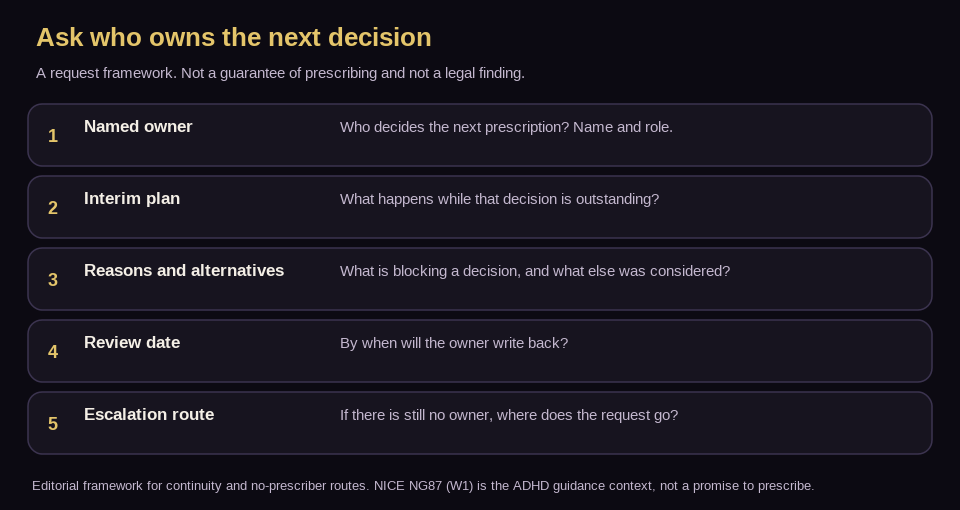
Read diagram text
Ask, in writing: named owner; interim plan; reasons and alternatives; review date; escalation route if there is still no owner.
Not a guarantee of prescribing. Not a legal determination. Editorial framework for the continuity and no-prescriber routes. W1 is ADHD guidance context only and does not specify this five-box form.
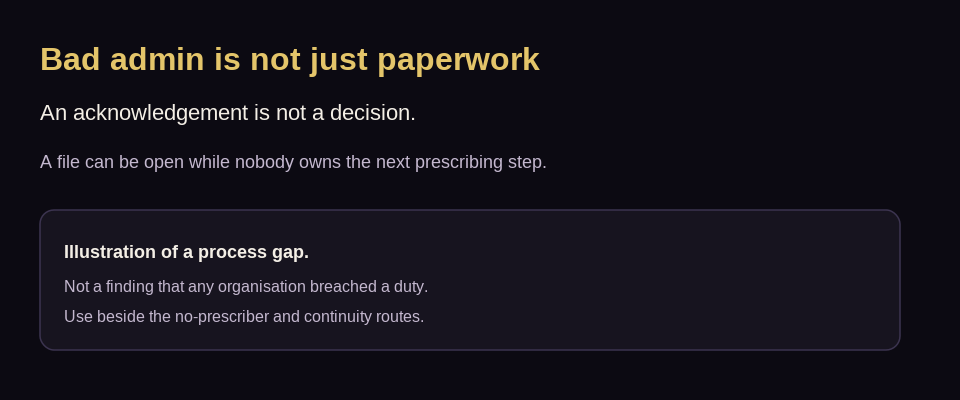
Read diagram text
Bad admin is not just paperwork
An acknowledgement is not a decision.
A file can be open while nobody owns the next prescribing step.
Illustration of a process gap.
Not a finding that any organisation breached a duty.
Use beside the no-prescriber and continuity routes.
Possible explanations
- The referral has not yet been accepted — it is waiting for triage.
- It was accepted, but a prerequisite (for example a heart check) has no named owner.
- The prerequisite was met, but nobody was told to act on it.
- Two services each believe the other is responsible.
- A complaints process is handling the issue, and the clinical question has stopped moving.
In one case, a trust clinician confirmed the medication gap had been raised internally with the relevant leads, but said she had no role that would let her identify who would decide or when.
AUTHOR-ACCOUNTUseful next action
Fill this in and copy the result. Nothing you type leaves this page.
Continuity request worksheet
Write down your current treatment gap, its effects, the decision you need, who should own it, and a requested response date. Ask for the reasons, alternatives and interim plan in writing. Copy these prompts into a document to complete them.
Then record each answer: accepted referral, completed assessment and implemented plan are three different things — note which one you actually have.
Treatment logic
A prerequisite is not the same as a promise. If a service says medication "cannot be considered until" a check is done, the natural follow-up once the check is done is: what is now outstanding, and who owns it?
One trust wrote that ADHD medication "cannot be considered until full cardiology checks have been completed".
AUTHOR-ACCOUNTUseful questions
- Which service and clinician own the next decision?
- What is outstanding, who will obtain it, and by when?
- What is the interim safety and support plan?
Uncertainty
Services differ in how they triage and who can prescribe. A named owner speeds things up but does not guarantee a particular outcome.
Sources cited
- W1 NICE. Attention deficit hyperactivity disorder: diagnosis and management (NG87). 2018, updated 2019. Recommendations 1.7.11–1.7.14 (adult medication choice) and section 1.10 (review and discontinuation). link (Official text via search snippets and NHS shared-care documents quoting it; main page fetch blocked)
- AUTHOR-ACCOUNT Author’s account, published with the author’s authorization (Personal account; not independently verified from public case documents)
Inherited from the published site at commit 8d4030af8fce. Not independently re-checked. Original page