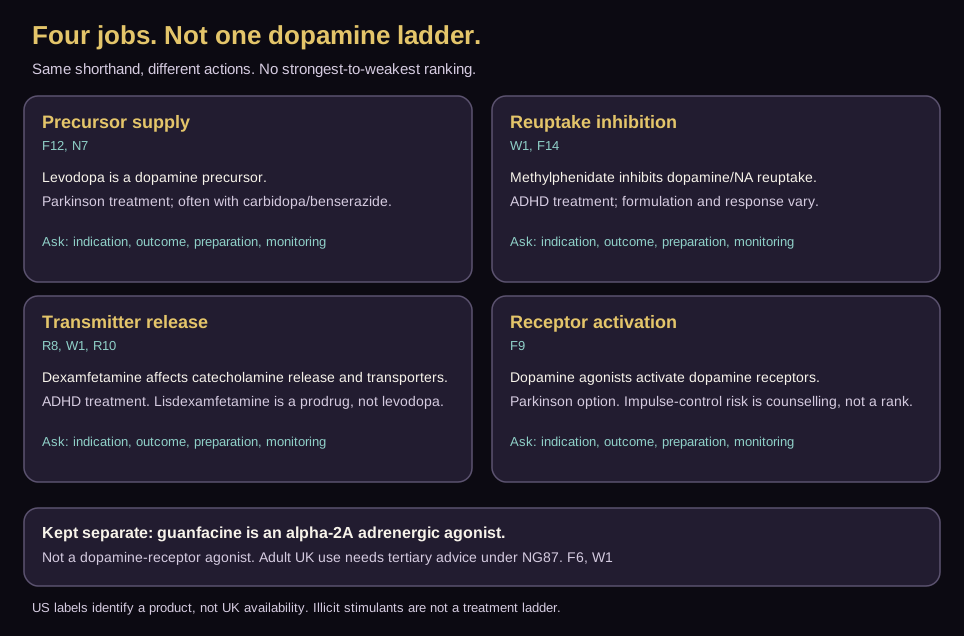
Precursor supply, reuptake inhibition, transmitter release and receptor activation are different interventions. Compare the indication and evidence as well as the mechanism.
1 · Quick understanding
“Acts on dopamine” does not identify one treatment class or one shared disease. The same shorthand can describe medicines doing substantially different jobs. Start with what is being treated and how benefit is measured.
Four different actions, with a question beside each. Not a dopamine potency or safety ladder. Guanfacine is kept separate from dopamine-receptor agonism.Read diagram text
Precursor supply: levodopa, often with carbidopa or benserazide. Parkinson symptom treatment. F12, N7.
Reuptake inhibition: methylphenidate. ADHD treatment. Not a precursor. W1, F14.
Transmitter release: dexamfetamine. Lisdexamfetamine is a prodrug of dexamfetamine, not levodopa. R8, W1, R10.
Receptor activation: dopamine agonists. Parkinson option with impulse-control risk. F9.
Separate: guanfacine is an alpha-2A adrenergic agonist, not a dopamine-receptor agonist. F6, W1.
Ask beside each: indication, outcome, preparation, monitoring. No potency or safety ladder. US labels are not UK availability. Illicit stimulants are not a treatment ladder.
2 · Mechanism and indication map
Intervention
Main distinction
Evidence and context
Levodopa
Dopamine precursor; commonly paired with carbidopa or benserazide
Established Parkinson symptom treatment; specialist use for specific movement disorders F12N7
Methylphenidate
Dopamine/noradrenaline reuptake inhibition
ADHD treatment; individual response and formulation matter W1
Dexamfetamine
Catecholamine release and transporter effects
ADHD treatment; differs from a dopamine precursor R8W1
Lisdexamfetamine
Prodrug converted to dexamfetamine
Conversion changes exposure timing; it is not levodopa R10
Adderall
Mixed amphetamine salts
US ADHD product; not identical to dexamfetamine-only medicine F7
Atomoxetine
Noradrenaline-transporter inhibition
ADHD treatment with its own evidence and response profile F5W1
Guanfacine
Alpha-2A adrenergic receptor agonist
Receptor target differs from a dopamine agonist; adult UK use needs tertiary-service advice under NG87 F6W1
Dopamine agonists
Activate dopamine receptors
Parkinson options with specific benefits and impulse-control risks F9
Saffron
Human ADHD evidence exists; therapeutic mechanism remains unresolved
Preliminary studies do not establish equivalence to a selective dopamine reuptake inhibitor F1
Mucuna
Contains levodopa
Parkinson studies require attention to preparation and population F3F4
3 · Useful next action
Ask what symptom or impairment an option is meant to improve; which population was studied; what monitoring is needed; and why this option fits your clinical assessment. An inadequate response should lead to a review of the plan and alternatives.
4 · Cocaine, crack and methamphetamine in the comparison
Cocaine blocks dopamine reuptake; exposure and effects also depend on delivery. Crack is a smokeable form of cocaine. Shared stimulant mechanisms do not make different substances or preparations therapeutically interchangeable.
Methamphetamine has a US prescription ADHD product label. That does not establish the safety, quality or clinical equivalence of illicit methamphetamine, or current UK prescribing availability.
This is a pharmacology comparison. Cocaine/crack are not established ADHD treatments. No evidence reviewed here supports using them as substitutes for a prescribed treatment plan. Regulated formulation, delivery, evidence, interactions and monitoring are substantive parts of treatment.
5 · Where standard shorthand fails
Calling every non-stimulant a general stabiliser overlooks that atomoxetine is an ADHD treatment and guanfacine has a specific receptor target. Calling every “agonist” a dopamine agonist confuses different receptor families.
NICE recommends atomoxetine for adults unable to tolerate, or inadequately responding to, specified stimulant trials. Adults with persistent non-response after stimulant and non-stimulant treatment warrant specialist escalation.
This targeted map is not a complete interaction review or a head-to-head comparison of every listed option. “More dopamine” is not a general measure of better function, and symptom response does not measure a person's dopamine concentration.
Sources cited
F12 NHS. Parkinson disease: treatment. Page last reviewed November 2022. link(Full webpage read; general complementary-therapy wording predates trial F3)
N7 MedlinePlus Genetics — Dopa-responsive dystonia link(Webpage read; not an independent systematic review)
W1 NICE. Attention deficit hyperactivity disorder: diagnosis and management (NG87). 2018, updated 2019. Recommendations 1.7.11–1.7.14 (adult medication choice) and section 1.10 (review and discontinuation). link(Official text via search snippets and NHS shared-care documents quoting it; main page fetch blocked)
R8 Sulzer D, et al. Mechanisms of neurotransmitter release by amphetamines: a review. Progress in Neurobiology 2005;75(6):406–33. (Abstract read (PubMed))
R10 Pennick M. Absorption of lisdexamfetamine dimesylate and its enzymatic conversion to d-amphetamine. Neuropsychiatr Dis Treat 2010;6:317–27. (Abstract read (PubMed))
F9 NICE NG71. Parkinson disease in adults: medication choices and impulse-control risks. link(Indexed recommendation passages checked; direct page fetch blocked)
F6 DailyMed. Guanfacine extended-release prescribing information: mechanism and safety. US product label. link(Official label opened; indication and mechanism sections inspected)
F14 DailyMed. Ritalin (methylphenidate hydrochloride) prescribing information, section 12: reuptake mechanism. US label; not UK licensing evidence. link(Indexed official label mechanism passage inspected)
F7 DailyMed. Adderall mixed amphetamine salts prescribing information. US product label. link(Product composition and indication inspected; no claim about current UK availability)
F5 DailyMed. Atomoxetine prescribing information: indication and mechanism. US product label. link(Relevant label sections read; US label is not UK prescribing authorisation)
F1 Baziar et al. 2019. Saffron versus methylphenidate: six-week double-blind ADHD pilot, 54 children/adolescents randomised. DOI 10.1089/cap.2018.0146. link(Publisher abstract read; full paper not accessed)
F3 Cilia et al. Mucuna in untreated Parkinson disease in sub-Saharan Africa: 12-month randomised trial. Online November 2025; issue February 2026. DOI 10.1177/1877718X251383721. link(Publisher full text inspected: design, population, outcomes and adverse events)
F4 Cohen et al. 2022. Levodopa content of Mucuna supplements. JAMA Neurology. DOI 10.1001/jamaneurol.2022.2184. link(Full article read; 16 US commercial products, one sample per brand)
F8 SAMHSA. Treatment for Stimulant Use Disorders, TIP 33 (2021), chapters 2 and 3: cocaine, methamphetamine, prescription stimulants. link(Relevant indexed passages retrieved; direct chapter page blocked. Full chapter not read)
F13 DailyMed. Desoxyn (methamphetamine hydrochloride) medication guide. US product label. link(Medication guide read; label existence does not establish current UK access)