Take botanical treatments seriously enough to examine the trials, the product and the unanswered comparisons. Promising does not mean interchangeable.
1 · Quick understanding
A plant can contain a pharmacologically active substance. Its value depends on the clinical evidence and preparation, rather than whether the label says natural, supplement or medicine.
Population and limitations stay visible. No dose instructions and no claim that these preparations are interchangeable.Read diagram text
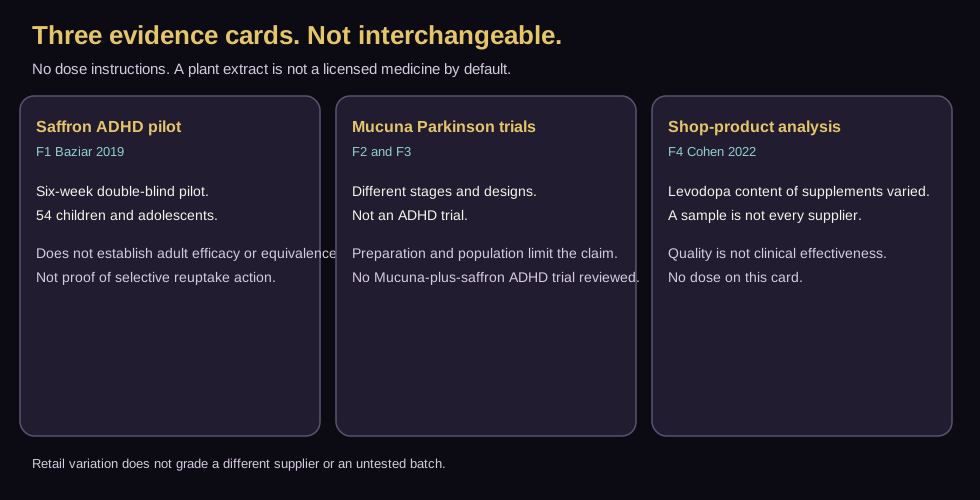
F1 Baziar 2019: six-week double-blind saffron versus methylphenidate pilot, 54 children and adolescents. Does not establish adult efficacy, equivalence, or selective reuptake action.
F2/F3: Mucuna trials in Parkinson disease, different stages and designs. Not an ADHD trial. No Mucuna-plus-saffron ADHD trial was reviewed.
F4 Cohen 2022: levodopa content of commercial Mucuna supplements varied. A sampled product does not establish another supplier or an untested batch. Product-quality evidence and clinical-effectiveness evidence are separate.
No dose instructions. No interchangeability claim.
2 · Saffron and ADHD
A six-week double-blind pilot randomised 54 children/adolescents to saffron or methylphenidate; 50 completed. It found no statistically significant between-group difference on symptom ratings, with similar reported adverse-effect frequency.
Editorial interpretation: failure to detect a difference in a small study is insufficient to establish clinical equivalence, adult effectiveness, long-term safety or a selective dopamine-reuptake mechanism. The abstract reviewed here does not settle those questions.
3 · Mucuna: read the contrasting trials
In a 2018 advanced-Parkinson crossover pilot, seven of fourteen participants stopped Mucuna early because of gastrointestinal effects or worsening motor performance; none stopped during the levodopa/carbidopa phase.
A newer 12-month open-label randomised phase-2 trial enrolled 35 previously untreated Parkinson patients in sub-Saharan Africa. It reported similar clinical outcomes with its characterised Mucuna preparation and standard levodopa treatment; two Mucuna participants discontinued because of adverse effects.
Editorial interpretation: these studies used different populations and protocols. The newer result deserves inclusion, while its small, unblinded design limits certainty. Neither is an ADHD trial or a test of a Mucuna-plus-saffron combination.
4 · Preparation matters
A 2022 analysis tested sixteen US Mucuna supplements. One had no detectable levodopa; the other fifteen varied widely, and extract quantities on labels did not reliably predict levodopa content. Only one sample per brand was tested.
The study characterises those sampled products; it does not establish the quality of a different supplier or a particular tested batch. A product-specific assessment should examine independent identity/content testing, the assay method, batch traceability and applicable quality standards. Provider reputation alone is not that evidence.
A characterised trial preparation and an unrelated retail product therefore require separate evidence. Share supplement use with the reviewing clinician/pharmacist: it may represent drug exposure, not just nutrition.
5 · A worked audit of standard advice
The NHS Parkinson treatment page reviewed in November 2022 uses broad wording about lack of clinical evidence for complementary approaches F12. For levodopa-containing Mucuna, that wording needs qualification alongside specific trials, including newer F3. This illustrates why dates, preparations and condition-specific evidence matter.
The evidence examined here does not establish that Mucuna plus saffron is more effective or safer than atomoxetine, guanfacine or dopamine agonists. That proposed comparison remains a research question.
6 · Useful next questions
Was the trial in my condition, age group and stage of illness?
Does this product match the studied preparation?
Was the result symptom improvement, disease modification or merely a lab measurement?
What comparative safety and combination evidence is actually available?
Uncertainty
This is a targeted evidence audit, not an exhaustive saffron or Mucuna review. Newer evidence may change estimates. Interaction and long-term safety gaps require assessment; absence of recorded harm in a small trial does not resolve them.
Sources cited
F1 Baziar et al. 2019. Saffron versus methylphenidate: six-week double-blind ADHD pilot, 54 children/adolescents randomised. DOI 10.1089/cap.2018.0146. link(Publisher abstract read; full paper not accessed)
F2 Cilia et al. 2018. Daily Mucuna in advanced Parkinson disease: 16-week crossover pilot. PMID 29352722. link(Indexed abstract/results retrieved through search; direct page incomplete)
F3 Cilia et al. Mucuna in untreated Parkinson disease in sub-Saharan Africa: 12-month randomised trial. Online November 2025; issue February 2026. DOI 10.1177/1877718X251383721. link(Publisher full text inspected: design, population, outcomes and adverse events)
F4 Cohen et al. 2022. Levodopa content of Mucuna supplements. JAMA Neurology. DOI 10.1001/jamaneurol.2022.2184. link(Full article read; 16 US commercial products, one sample per brand)
F12 NHS. Parkinson disease: treatment. Page last reviewed November 2022. link(Full webpage read; general complementary-therapy wording predates trial F3)