All diagrams in supply, synthesis and cofactors
Catecholamine synthesis and cell type branches
The catecholamine branch depends on which enzymes a cell expresses. Not every dopamine-producing neuron makes noradrenaline or adrenaline.
Catecholamine synthesis and cell type branches
Scoped educational mechanism
Open larger diagram · Full-size PNG · Diagram page
Read the diagram explanation and sources
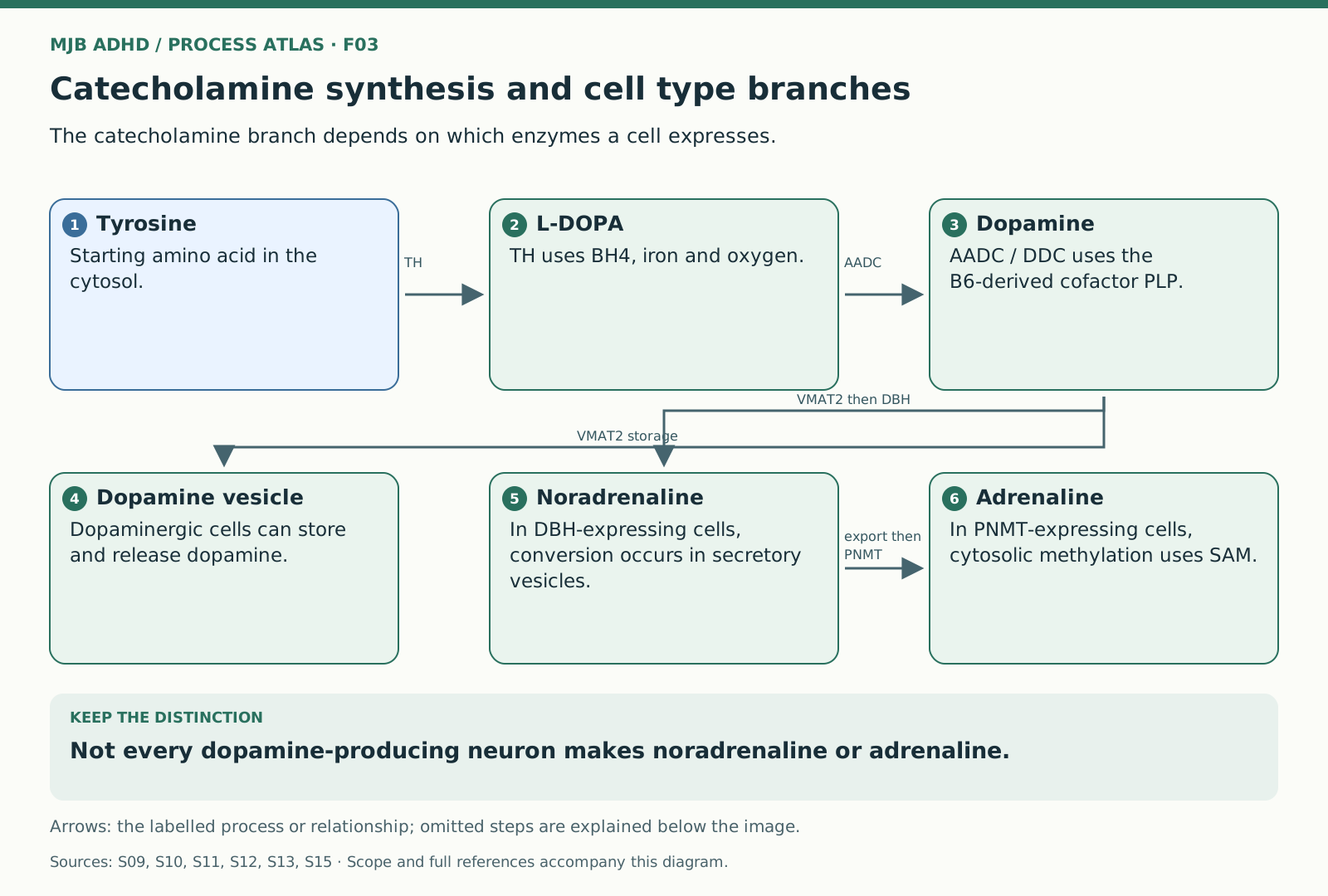
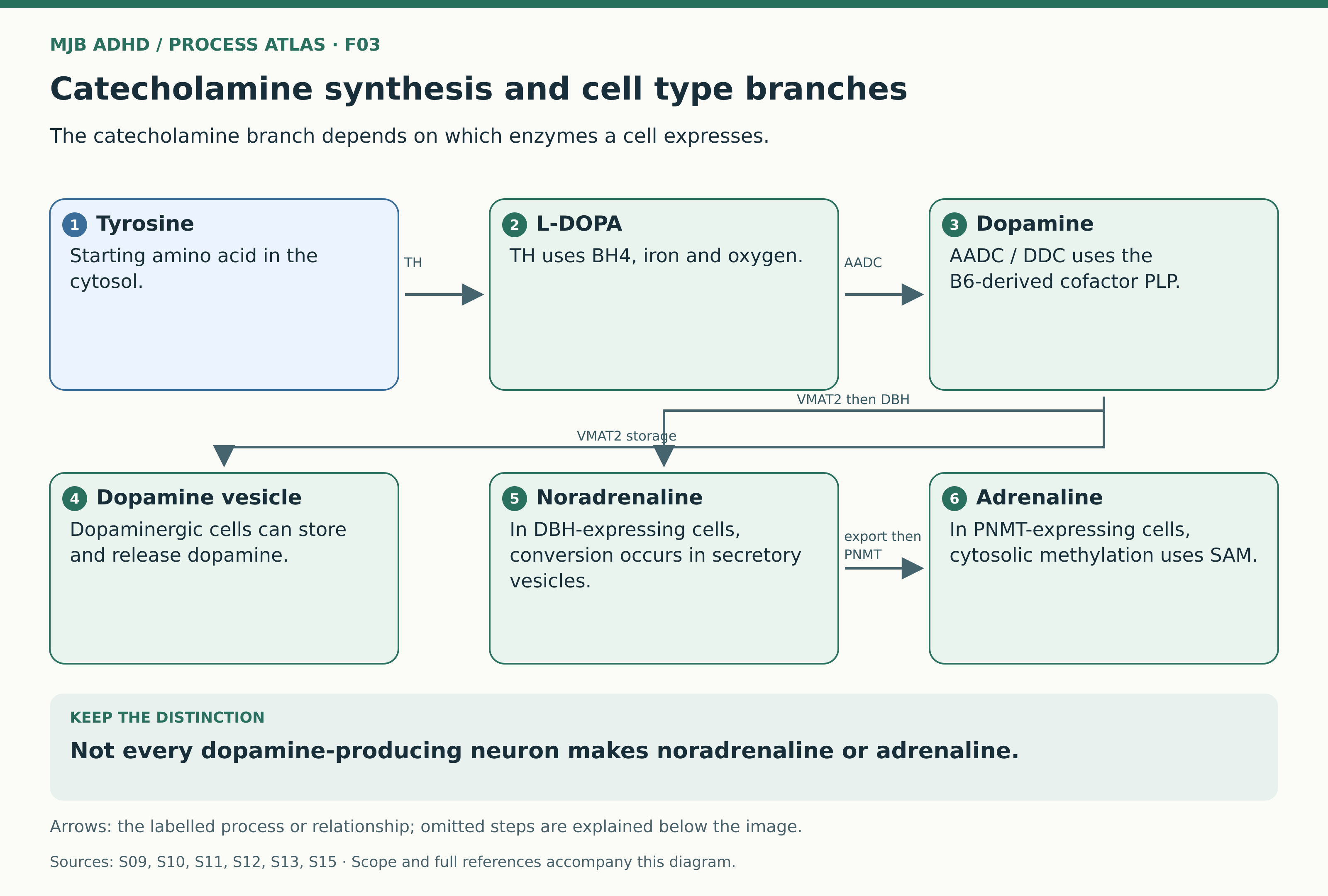
Tyrosine hydroxylase forms L-DOPA in the cytosol; aromatic L-amino acid decarboxylase forms dopamine. VMAT2 can transport dopamine into secretory vesicles. In cells expressing dopamine beta-hydroxylase, dopamine is converted to noradrenaline inside those vesicles, using copper and ascorbate. In cells expressing PNMT, noradrenaline returns to the cytosol for SAM-dependent conversion to adrenaline, which can be repackaged. These are cell-specific branches, not a compulsory chain in every dopamine neuron. Dopamine is the same molecule in peripheral and brain compartments.
- Tyrosine → L-DOPA: TH
- L-DOPA → Dopamine: AADC
- Dopamine → Dopamine vesicle: VMAT2 storage
- Dopamine → Noradrenaline: VMAT2 then DBH
- Noradrenaline → Adrenaline: export then PNMT
What the diagram shows
Tyrosine hydroxylase forms L-DOPA in the cytosol; aromatic L-amino acid decarboxylase forms dopamine. VMAT2 can transport dopamine into secretory vesicles. In cells expressing dopamine beta-hydroxylase, dopamine is converted to noradrenaline inside those vesicles, using copper and ascorbate. In cells expressing PNMT, noradrenaline returns to the cytosol for SAM-dependent conversion to adrenaline, which can be repackaged. These are cell-specific branches, not a compulsory chain in every dopamine neuron. Dopamine is the same molecule in peripheral and brain compartments.