All diagrams in synapses and receptor signalling
Vesicle loading and storage
ATP powers the vesicle's proton pump. VMAT2 uses the resulting proton gradient to load monoamines for storage and later release; it is not directly powered by ATP. This normal mechanism does not establish an individual transport defect.
Vesicle loading and storage
Established transport mechanism
Open larger diagram · Full-size PNG · Diagram page
Read the diagram explanation and sources
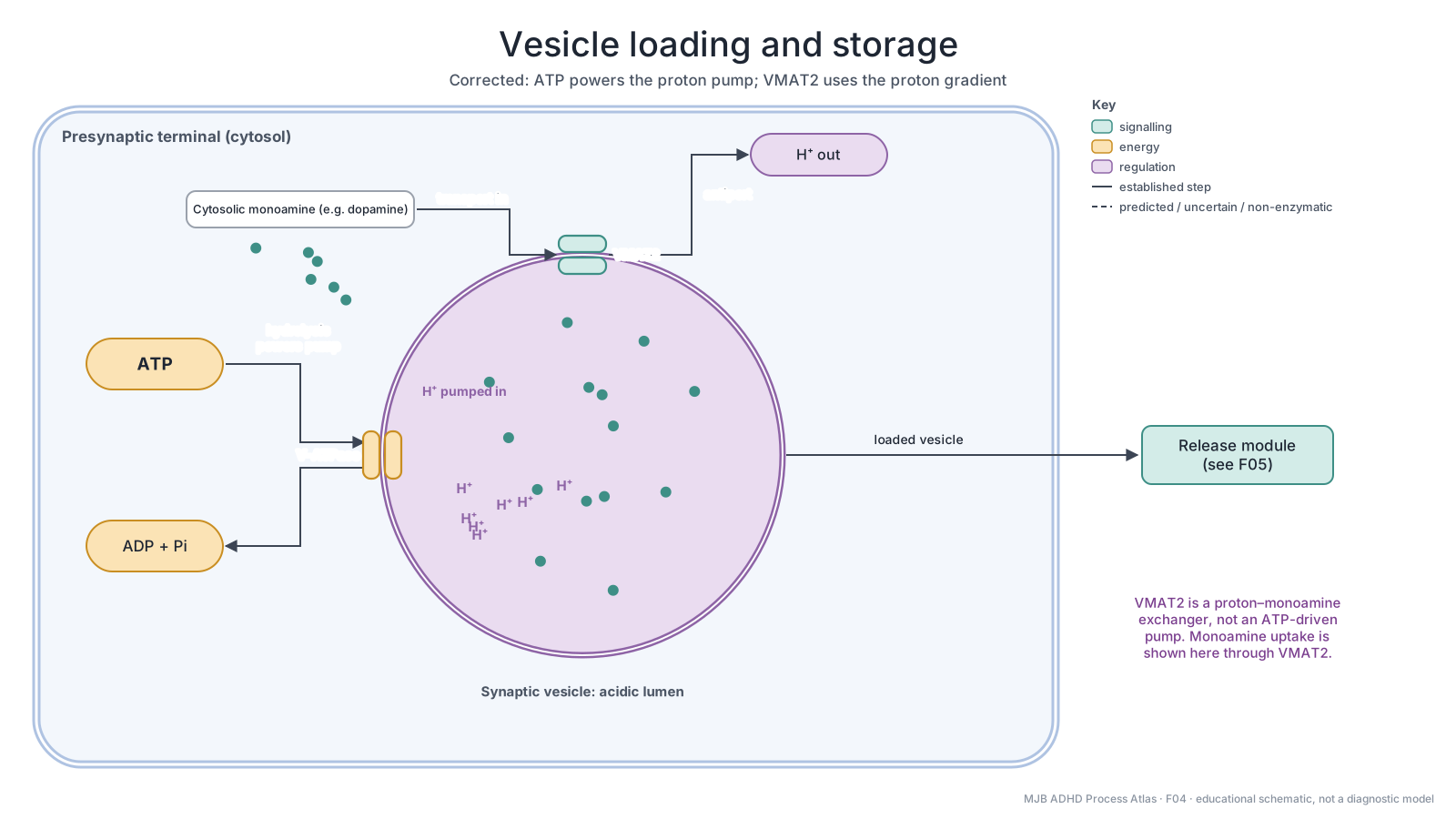
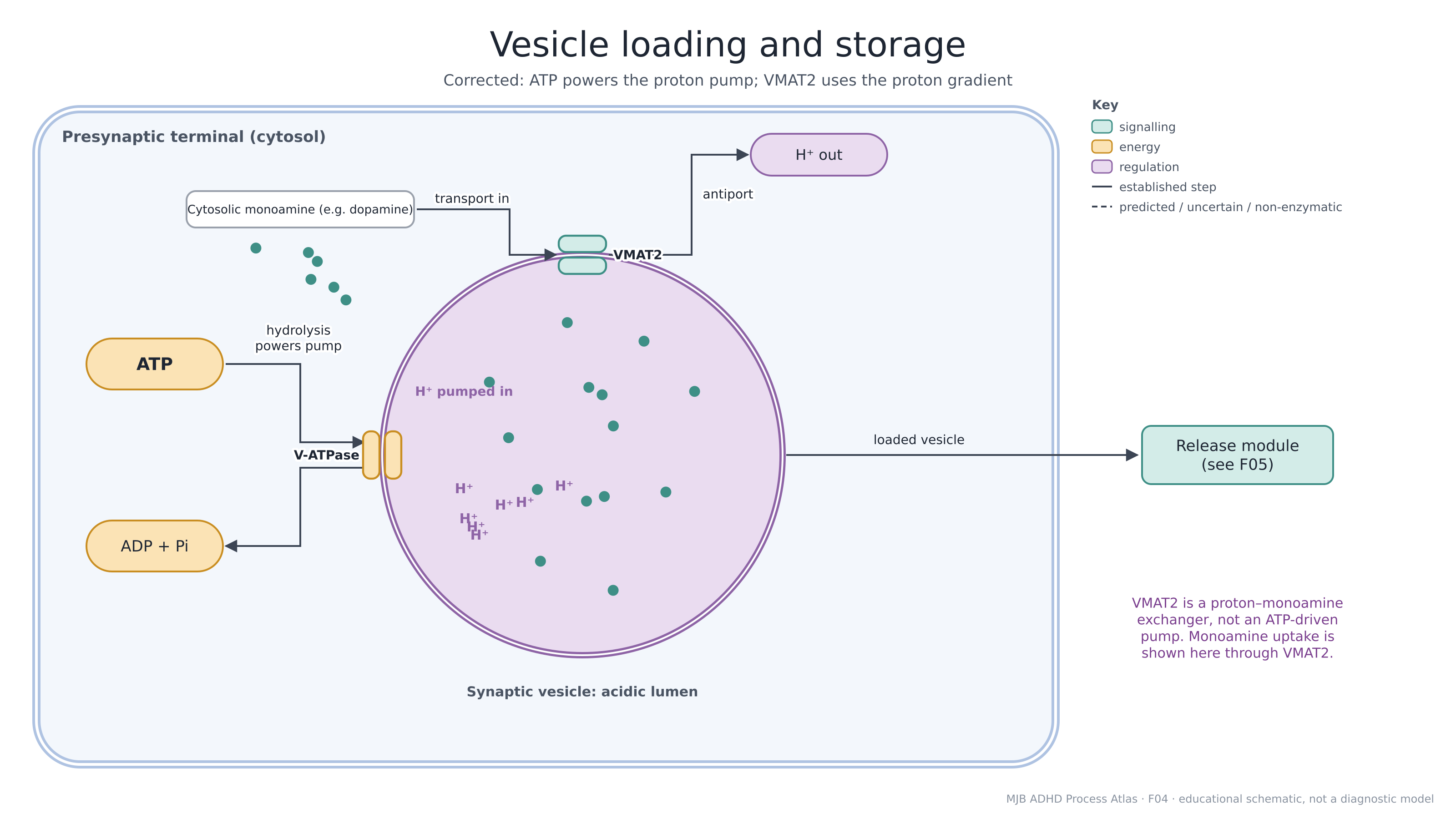
ATP hydrolysis powers the vesicular proton pump, V-ATPase, which acidifies the vesicle. VMAT2 exchanges vesicular protons for cytosolic monoamines such as dopamine. It therefore uses an existing proton gradient rather than directly hydrolysing ATP itself. Stored transmitter can subsequently be released by exocytosis. This explains a normal mechanism, not evidence of a VMAT2 defect in a particular reader.
What the diagram shows
ATP hydrolysis powers the vesicular proton pump, V-ATPase, which acidifies the vesicle. VMAT2 exchanges vesicular protons for cytosolic monoamines such as dopamine. It therefore uses an existing proton gradient rather than directly hydrolysing ATP itself. Stored transmitter can subsequently be released by exocytosis. This explains a normal mechanism, not evidence of a VMAT2 defect in a particular reader.