About reading this page
This page is one continuous article. Steps and split are for the short explanations, which were written as a finite set of steps. Saving does not mark this page as read. Listening uses a voice on this device. Some voices use an online service.
Home / science / process atlas / Release and vesicle recycling
All diagrams in synapses and receptor signalling
Release and vesicle recycling
Electrical activity, calcium entry and vesicle fusion are distinct steps. Vesicle membrane recycling is different from amino-acid recycling.
Release and vesicle recycling
Scoped educational mechanism
Open larger diagram · Full-size PNG · Diagram page
Read the diagram explanation and sources
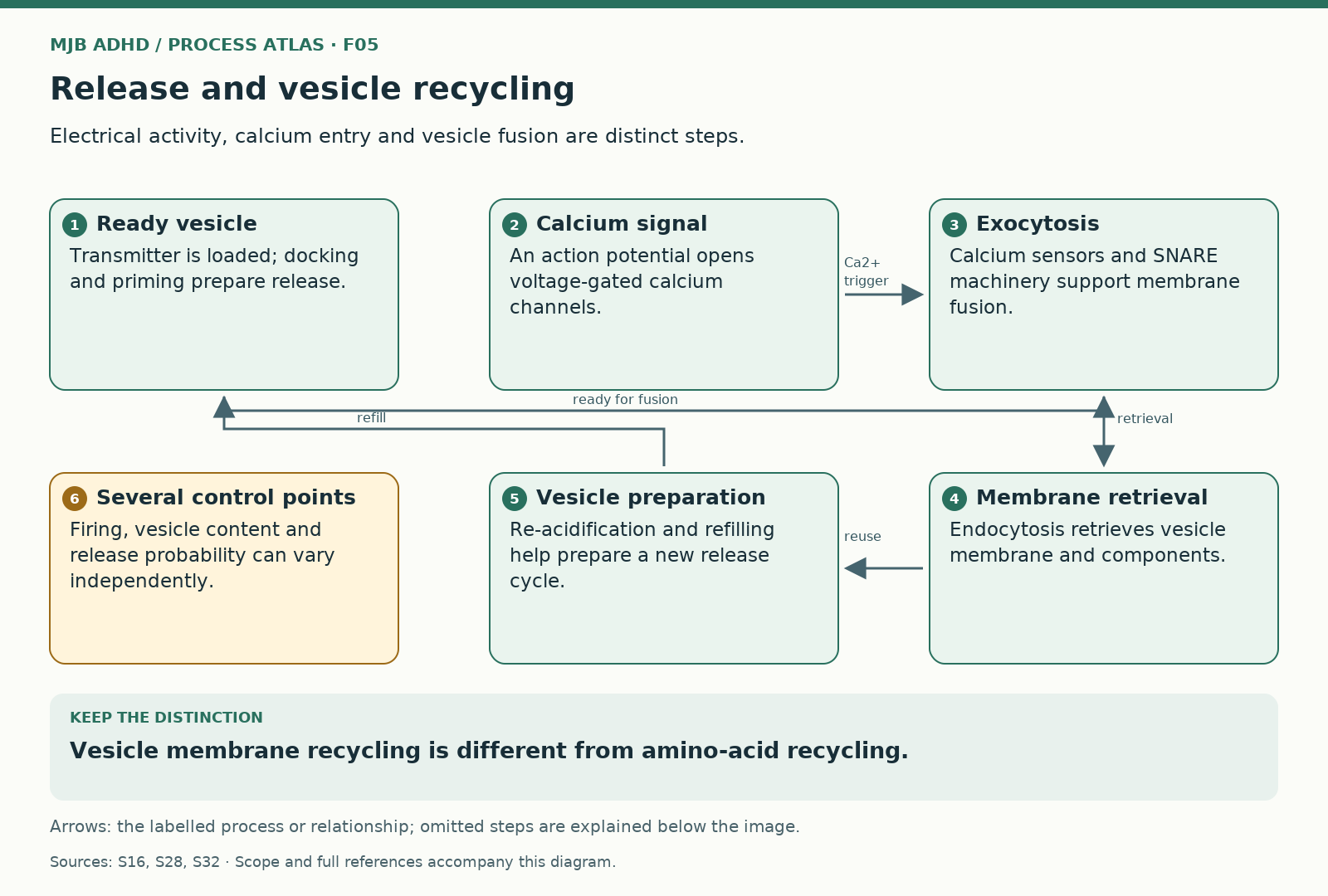
At chemical synapses, action potentials and presynaptic calcium entry can trigger fusion of prepared vesicles. Calcium-sensing proteins and the SNARE machinery participate in release. Membrane retrieval and vesicle preparation permit reuse, but release and recycling comprise multiple processes rather than one invariant conveyor belt. Firing rate, vesicle loading, the size of the ready pool and release probability are separate controls. The diagram illustrates established synaptic physiology and does not locate an ADHD-specific release defect.
- Ready vesicle → Exocytosis: ready for fusion
- Calcium signal → Exocytosis: Ca2+ trigger
- Exocytosis → Membrane retrieval: retrieval
- Membrane retrieval → Vesicle preparation: reuse
- Vesicle preparation → Ready vesicle: refill
What the diagram shows
At chemical synapses, action potentials and presynaptic calcium entry can trigger fusion of prepared vesicles. Calcium-sensing proteins and the SNARE machinery participate in release. Membrane retrieval and vesicle preparation permit reuse, but release and recycling comprise multiple processes rather than one invariant conveyor belt. Firing rate, vesicle loading, the size of the ready pool and release probability are separate controls. The diagram illustrates established synaptic physiology and does not locate an ADHD-specific release defect.
Inherited from the published site at commit 8d4030af8fce. Not independently re-checked. Original page