All diagrams in synapses and receptor signalling
Acetylcholine and attention modulation
Acetylcholine is made, released, hydrolysed and its choline reused. DAT and MAO are not the main acetylcholine clearance pathway.
Acetylcholine and attention modulation
Scoped educational mechanism
Open larger diagram · Full-size PNG · Diagram page
Read the diagram explanation and sources
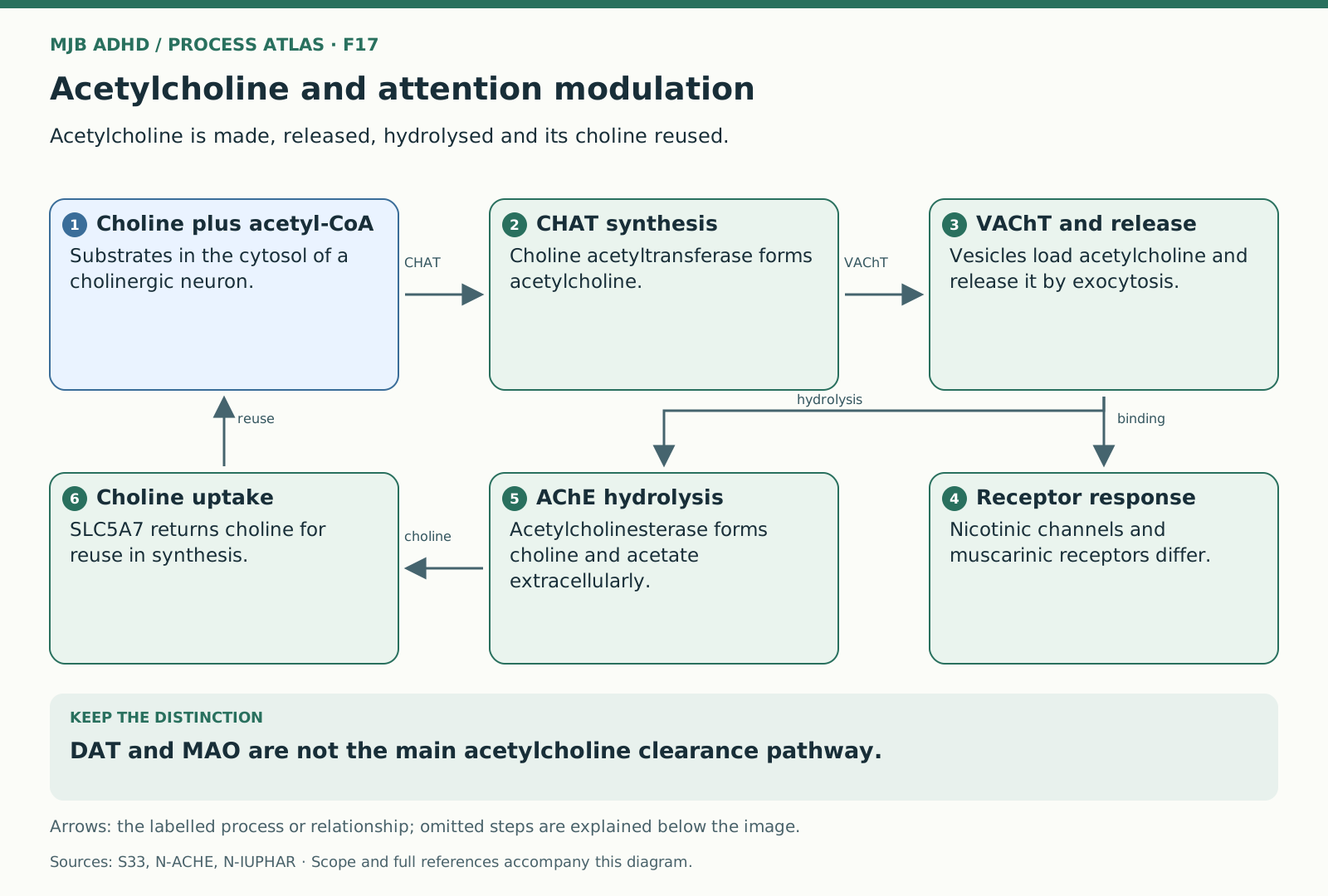
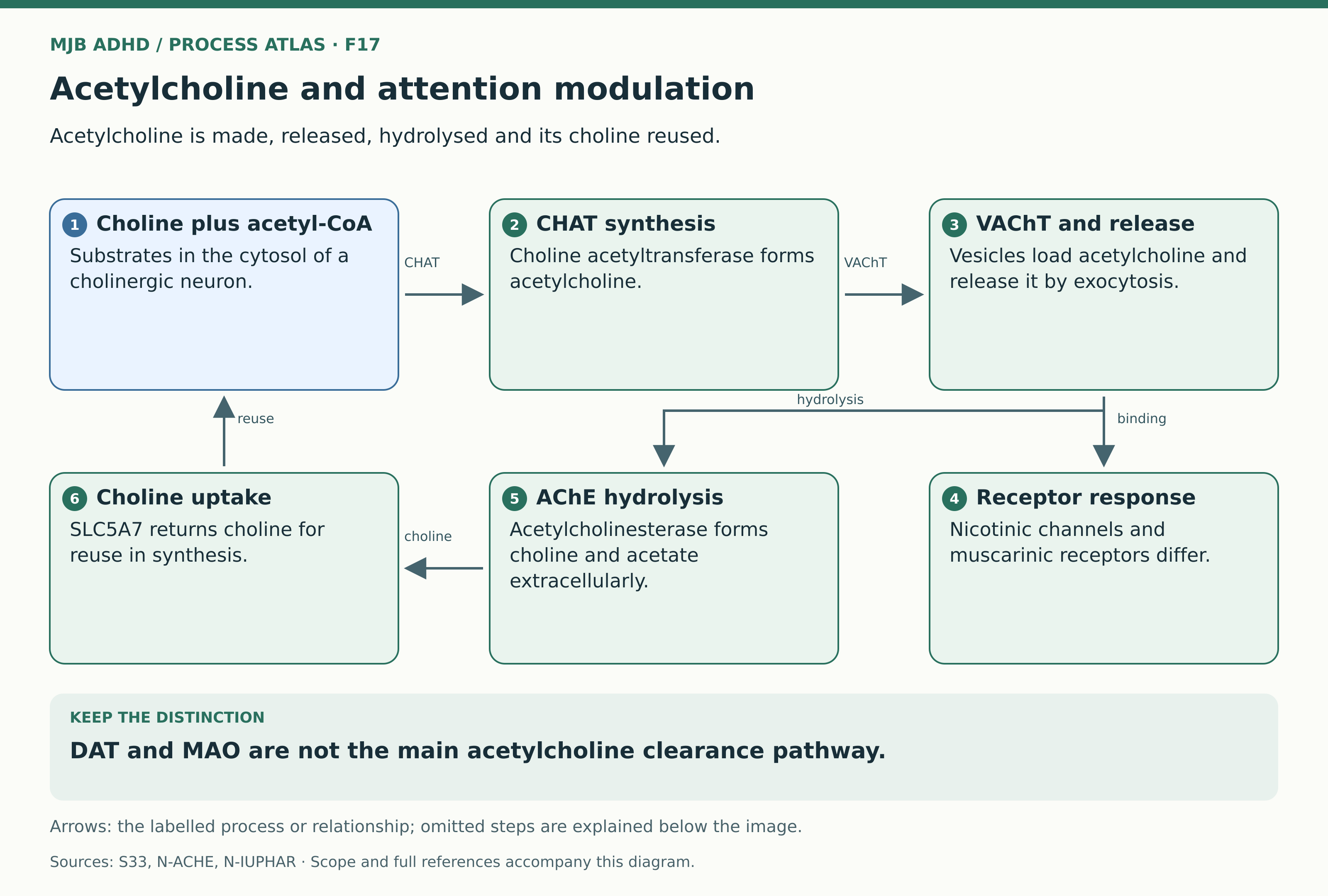
Choline acetyltransferase synthesises acetylcholine from choline and acetyl-CoA. Vesicular transport and calcium-dependent exocytosis support release. Acetylcholinesterase, associated with extracellular membrane surfaces, rapidly hydrolyses the transmitter, and choline uptake supplies material for reuse. Nicotinic and muscarinic receptors act differently. Acetylcholine participates in many central and peripheral functions; a mechanism cartoon does not imply an attention-specific defect or justify an individual treatment.
- Choline plus acetyl-CoA → CHAT synthesis: CHAT
- CHAT synthesis → VAChT and release: VAChT
- VAChT and release → Receptor response: binding
- VAChT and release → AChE hydrolysis: hydrolysis
- AChE hydrolysis → Choline uptake: choline
- Choline uptake → Choline plus acetyl-CoA: reuse
What the diagram shows
Choline acetyltransferase synthesises acetylcholine from choline and acetyl-CoA. Vesicular transport and calcium-dependent exocytosis support release. Acetylcholinesterase, associated with extracellular membrane surfaces, rapidly hydrolyses the transmitter, and choline uptake supplies material for reuse. Nicotinic and muscarinic receptors act differently. Acetylcholine participates in many central and peripheral functions; a mechanism cartoon does not imply an attention-specific defect or justify an individual treatment.