All diagrams in energy and cellular support
Mitochondrial quality control: one mitophagy route
One mitochondrial quality-control pathway: PINK1–PRKN mitophagy. A normal quality-control pathway does not establish an ADHD mechanism.
Mitochondrial quality control: one mitophagy route
Scoped educational mechanism
Open larger diagram · Full-size PNG · Diagram page
Read the diagram explanation and sources
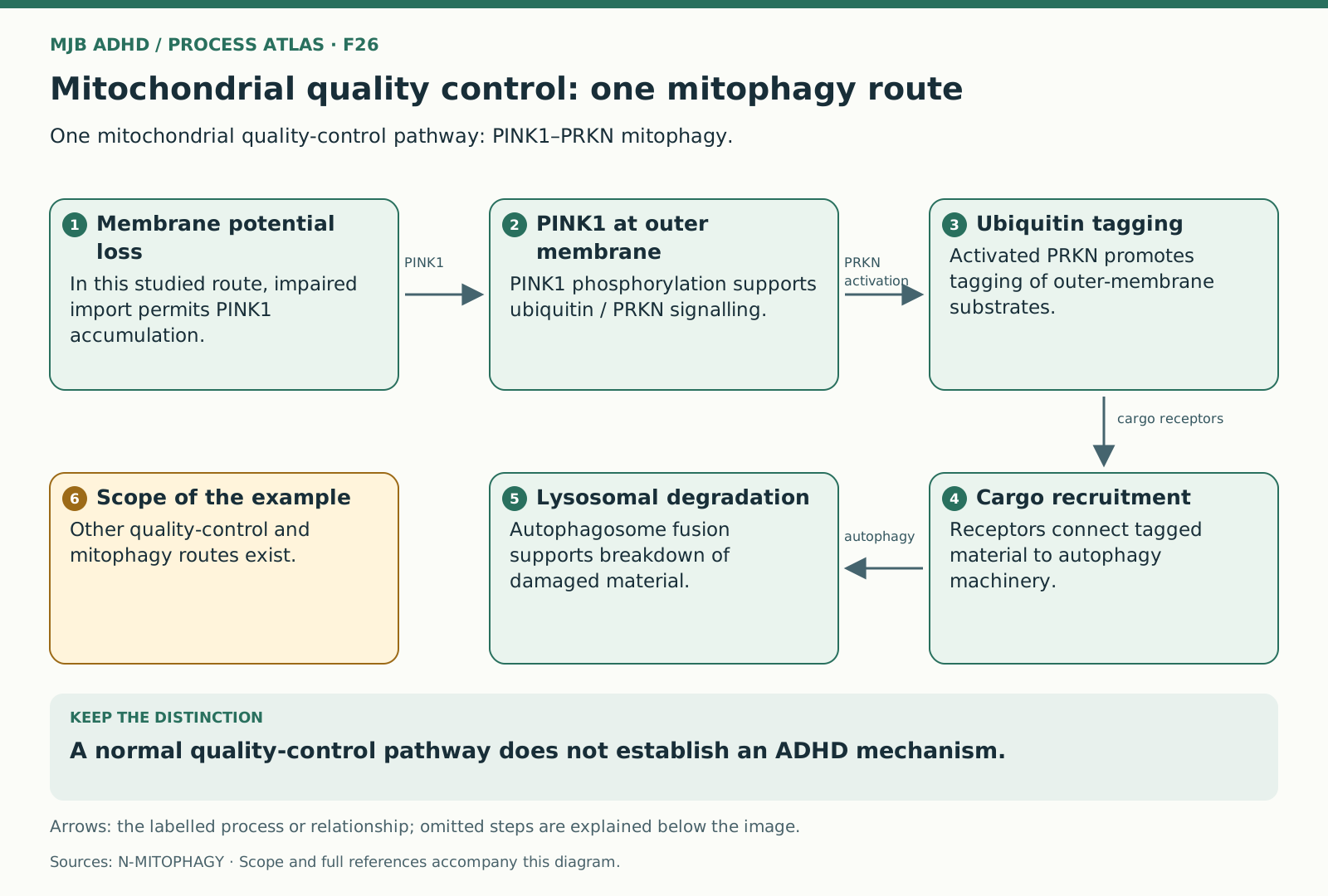
PINK1–PRKN-dependent mitophagy is a studied selective-removal route for damaged mitochondria. Loss of membrane potential can lead to PINK1 accumulation, phosphorylation of ubiquitin and PRKN activation, cargo recruitment and autophagy followed by lysosomal breakdown. Protein quality control and mitochondrial maintenance have other pathways too. This example does not assert that SPG7 is the same pathway, that a personal variant is pathogenic, or that quality-control failure explains ordinary ADHD.
- Membrane potential loss → PINK1 at outer membrane: PINK1
- PINK1 at outer membrane → Ubiquitin tagging: PRKN activation
- Ubiquitin tagging → Cargo recruitment: cargo receptors
- Cargo recruitment → Lysosomal degradation: autophagy
What the diagram shows
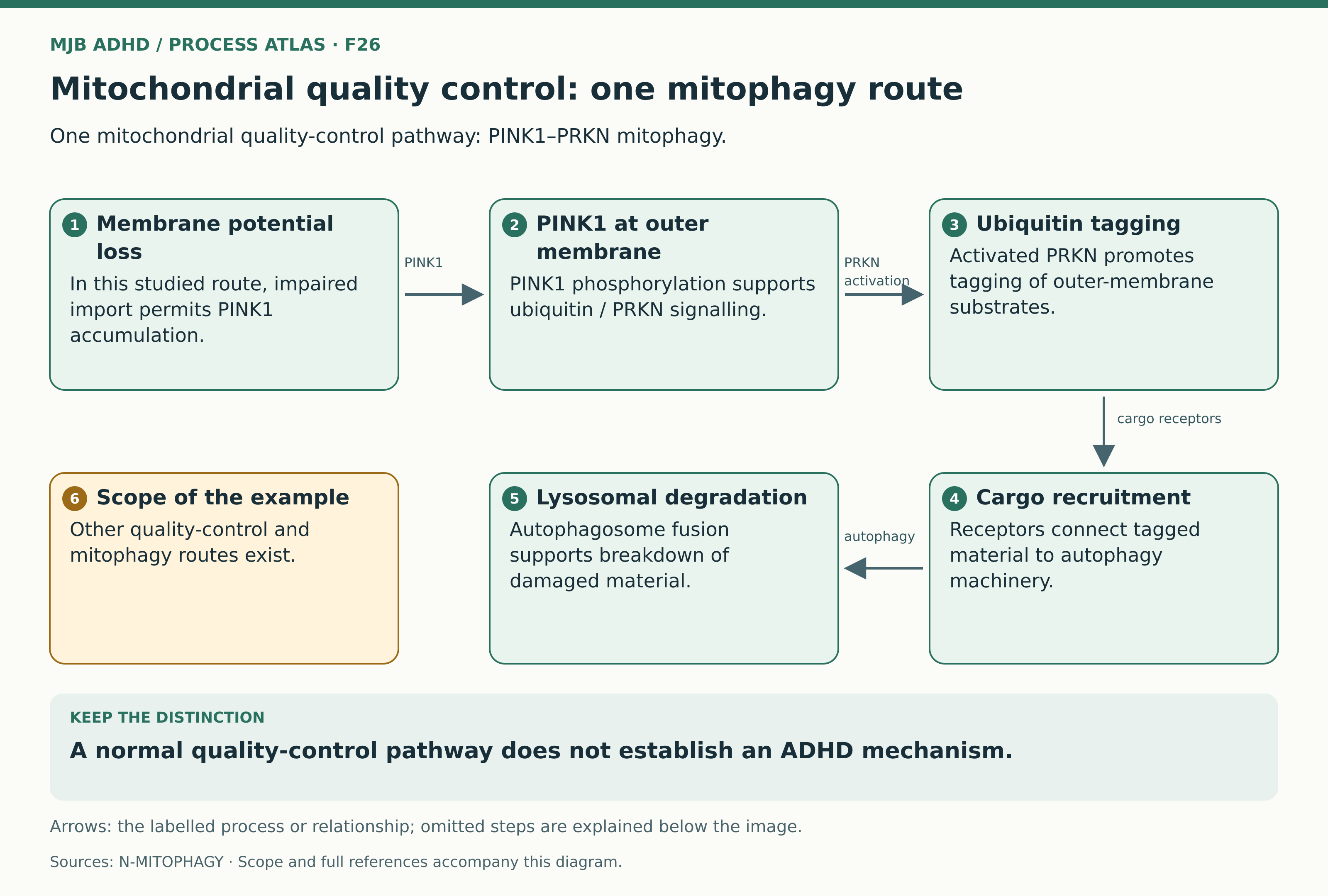
PINK1–PRKN-dependent mitophagy is a studied selective-removal route for damaged mitochondria. Loss of membrane potential can lead to PINK1 accumulation, phosphorylation of ubiquitin and PRKN activation, cargo recruitment and autophagy followed by lysosomal breakdown. Protein quality control and mitochondrial maintenance have other pathways too. This example does not assert that SPG7 is the same pathway, that a personal variant is pathogenic, or that quality-control failure explains ordinary ADHD.