All diagrams in overview and genetic evidence
Common locus to effector gene evidence
A genetic association identifies a region of interest. Connecting it to a candidate variant, gene and tissue-specific process requires several kinds of evidence. Each step has uncertainty; proximity alone does not establish causality.
Common locus to effector gene evidence
Evidence interpretation framework
Open larger diagram · Full-size PNG · Diagram page
Read the diagram explanation and sources
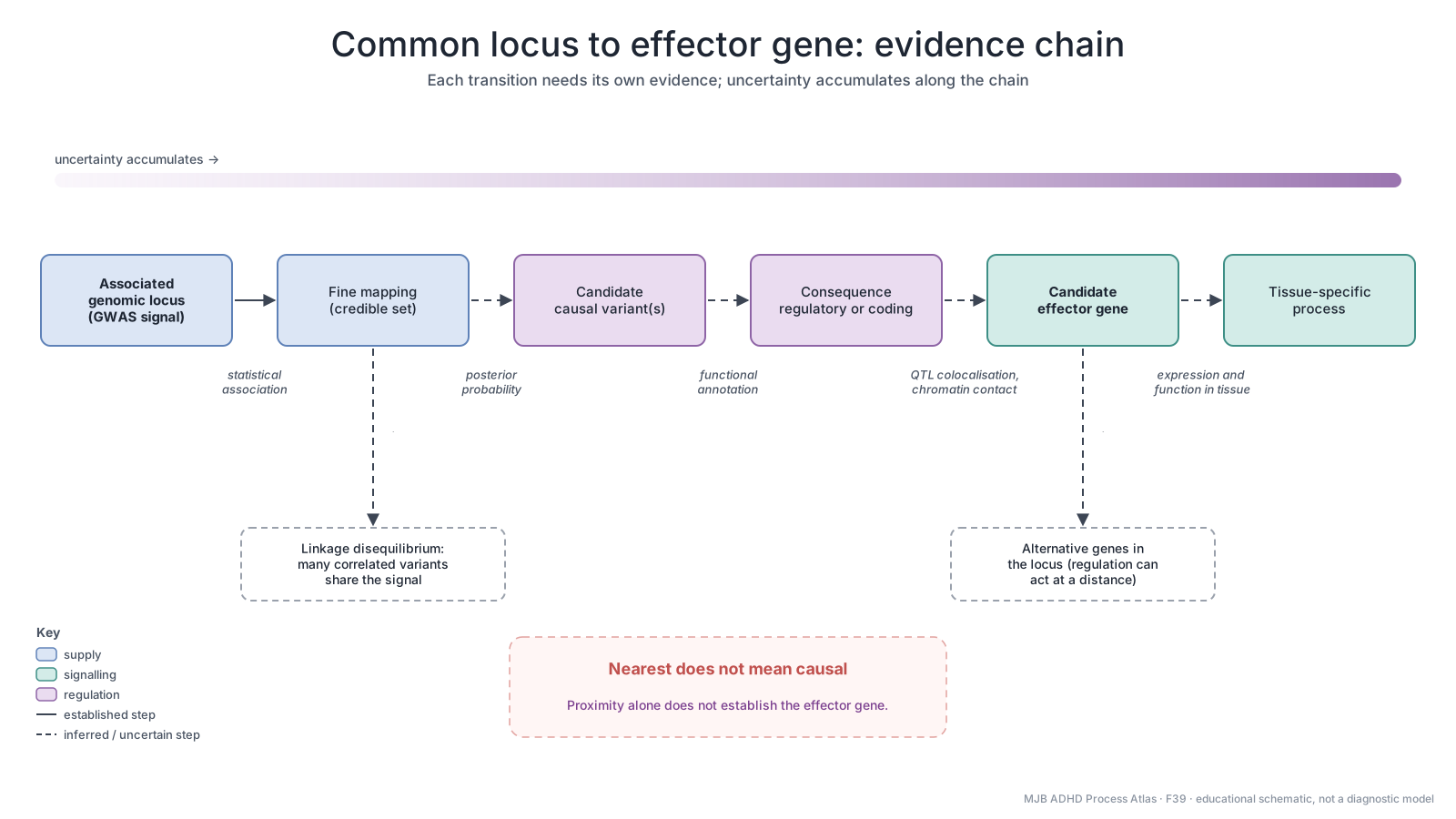
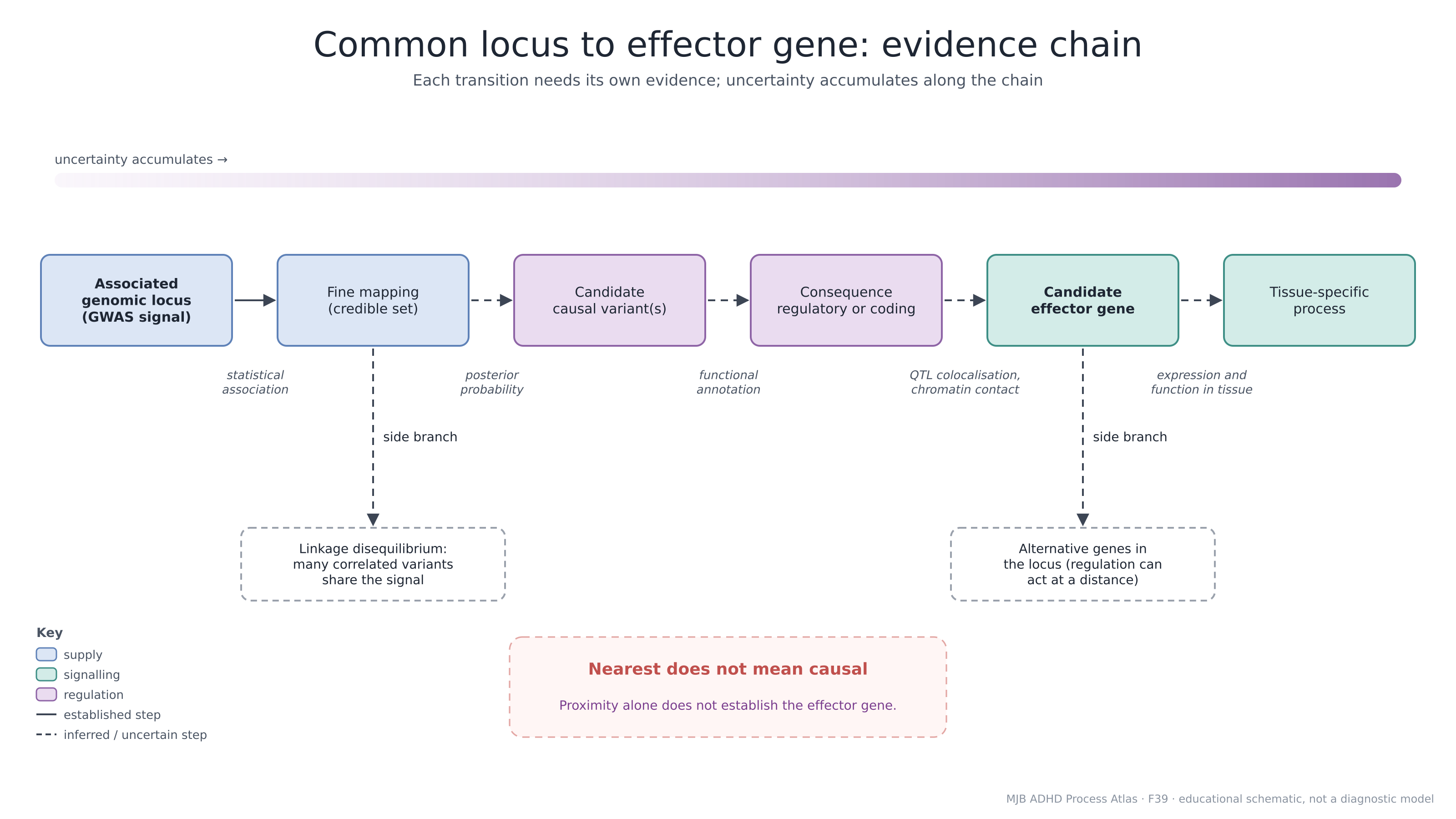
Begin with an associated locus, then evaluate fine-mapping, candidate variants, regulatory or coding consequences, potential effector genes and tissue-specific functions. Each step needs its own evidence. Linkage disequilibrium can leave several correlated candidates, and regulation may act over a distance. Proximity can be a clue but does not establish the causal gene by itself. These are complementary evidence types, not a mandatory sequence or a validated causal conclusion about one person.
What the diagram shows
Begin with an associated locus, then evaluate fine-mapping, candidate variants, regulatory or coding consequences, potential effector genes and tissue-specific functions. Each step needs its own evidence. Linkage disequilibrium can leave several correlated candidates, and regulation may act over a distance. Proximity can be a clue but does not establish the causal gene by itself. These are complementary evidence types, not a mandatory sequence or a validated causal conclusion about one person.