About reading this page
This page is one continuous article. Steps and split are for the short explanations, which were written as a finite set of steps. Saving does not mark this page as read. Listening uses a voice on this device. Some voices use an online service.
Home / science / process atlas / Amphetamine dexamfetamine at the dopamine terminal
All diagrams in medicine handling and targets
Amphetamine dexamfetamine at the dopamine terminal
Amphetamine mechanisms: experimental targets and clinical effects are distinct. A therapeutic dose or individual benefit cannot be read from this cartoon.
Amphetamine dexamfetamine at the dopamine terminal
Scoped educational mechanism
Open larger diagram · Full-size PNG · Diagram page
Read the diagram explanation and sources
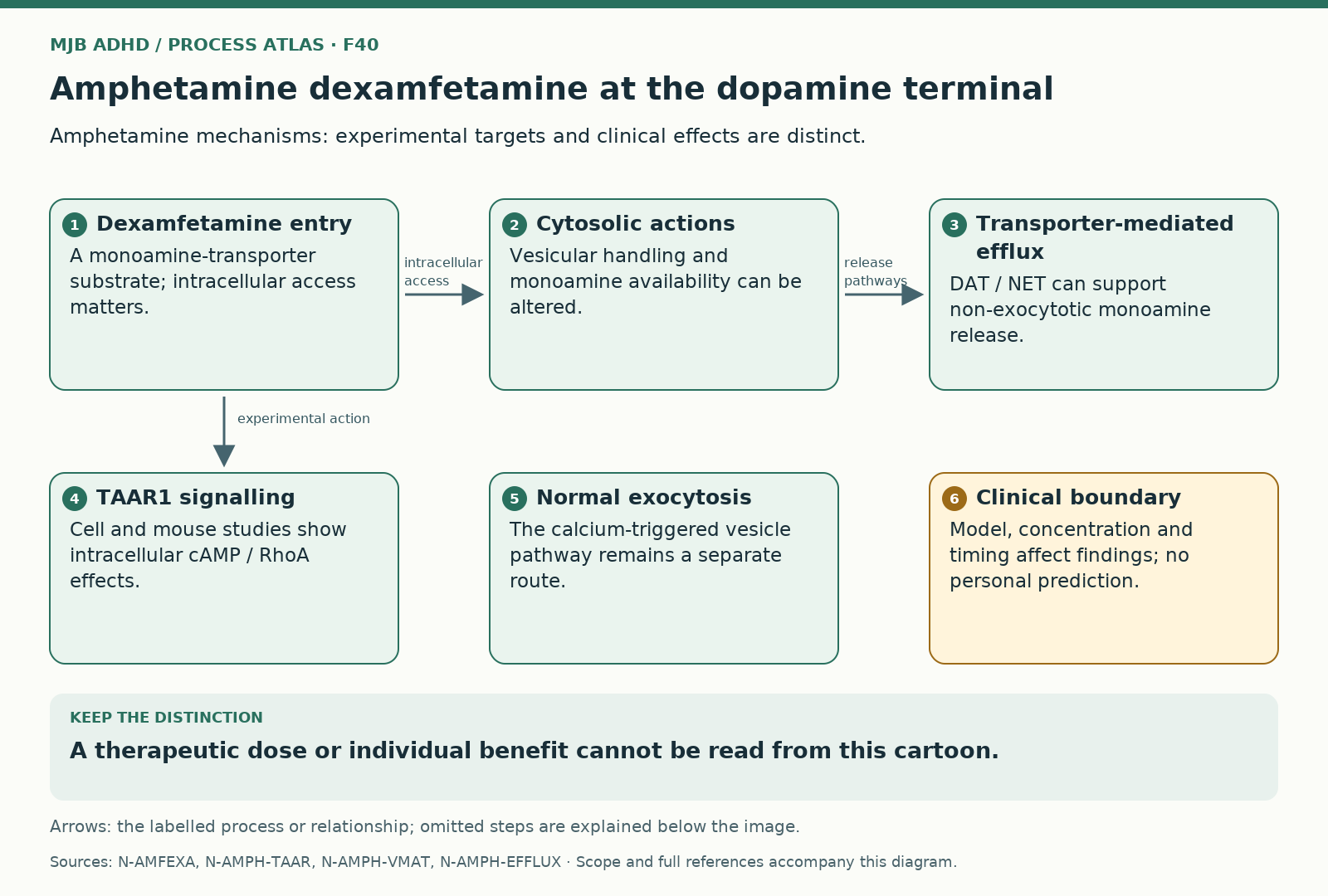
Amphetamine acts as a substrate at monoamine transporters and can alter intracellular monoamine handling and support transporter-mediated efflux. Experimental work also identifies intracellular TAAR1 signalling and transporter trafficking. Vesicular stores affect availability, but knockout-culture evidence shows vesicular transport is not an absolute prerequisite for every experimental amphetamine action. Calcium-triggered exocytosis is therefore kept separate from efflux. Models, concentration and exposure conditions limit translation. The UK dexamfetamine SmPC does not claim a fully settled explanation of behavioural benefit in ADHD. No dose, efficacy, safety or individual mechanism is inferred.
- Dexamfetamine entry → Cytosolic actions: intracellular access
- Cytosolic actions → Transporter-mediated efflux: release pathways
- Dexamfetamine entry → TAAR1 signalling: experimental action
What the diagram shows
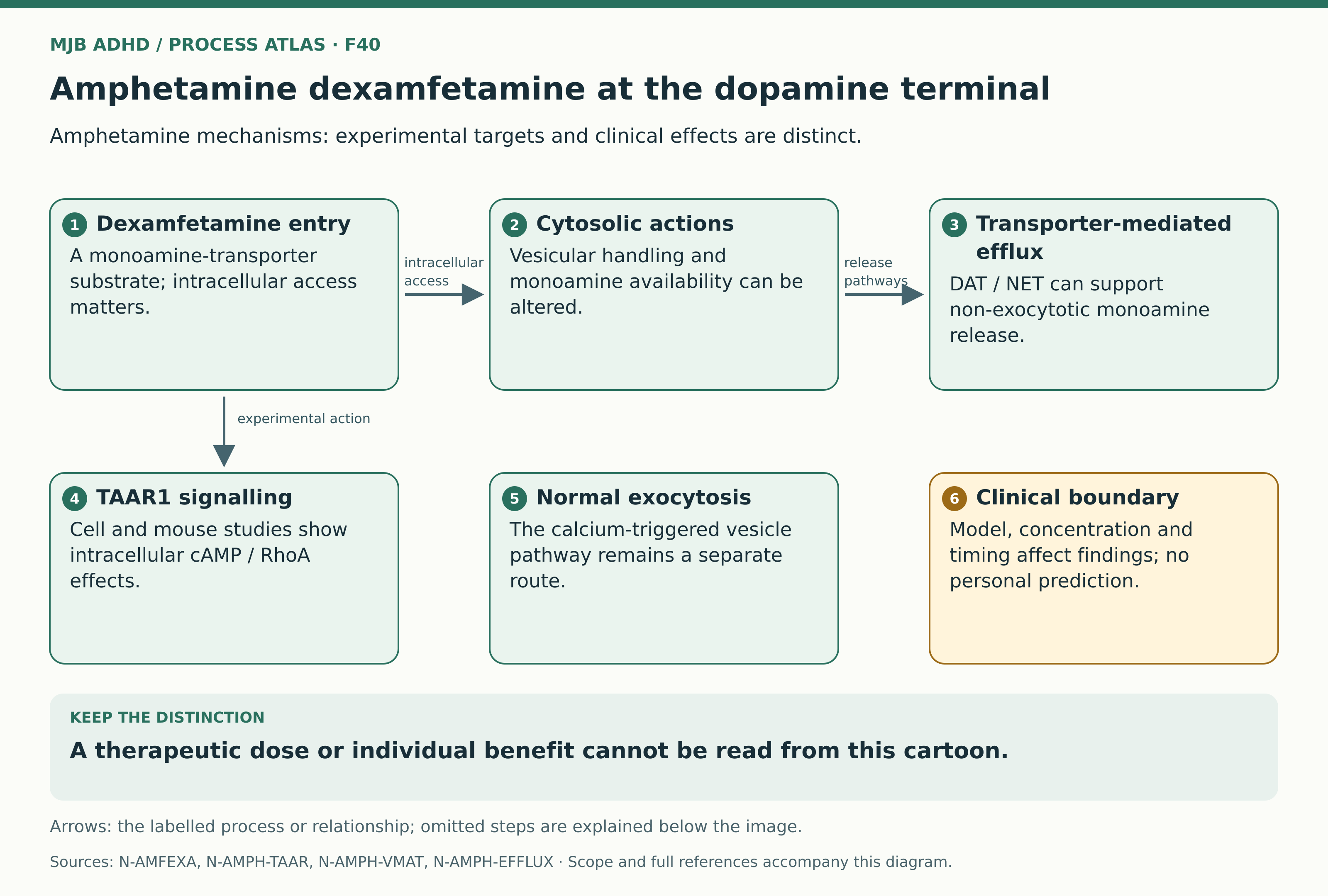
Amphetamine acts as a substrate at monoamine transporters and can alter intracellular monoamine handling and support transporter-mediated efflux. Experimental work also identifies intracellular TAAR1 signalling and transporter trafficking. Vesicular stores affect availability, but knockout-culture evidence shows vesicular transport is not an absolute prerequisite for every experimental amphetamine action. Calcium-triggered exocytosis is therefore kept separate from efflux. Models, concentration and exposure conditions limit translation. The UK dexamfetamine SmPC does not claim a fully settled explanation of behavioural benefit in ADHD. No dose, efficacy, safety or individual mechanism is inferred.
Inherited from the published site at commit 8d4030af8fce. Not independently re-checked. Original page