How to describe physical symptoms clearly without assuming ADHD explains everything — or nothing.
1 · Quick understanding
Some people notice that their ADHD medicine changes how their body moves, aches or tires, not only how they think. That is worth recording carefully. It can also be the first sign of a separate condition that needs its own assessment — so the aim is a clear account, not a conclusion.
Matthew reports that movement, posture and tightness were markedly better on a specific dexamfetamine product and worsened when it stopped.
A shared dopamine pathway could link attention and movement symptoms in some people. This is a research question with competing explanations — see Open research questions.
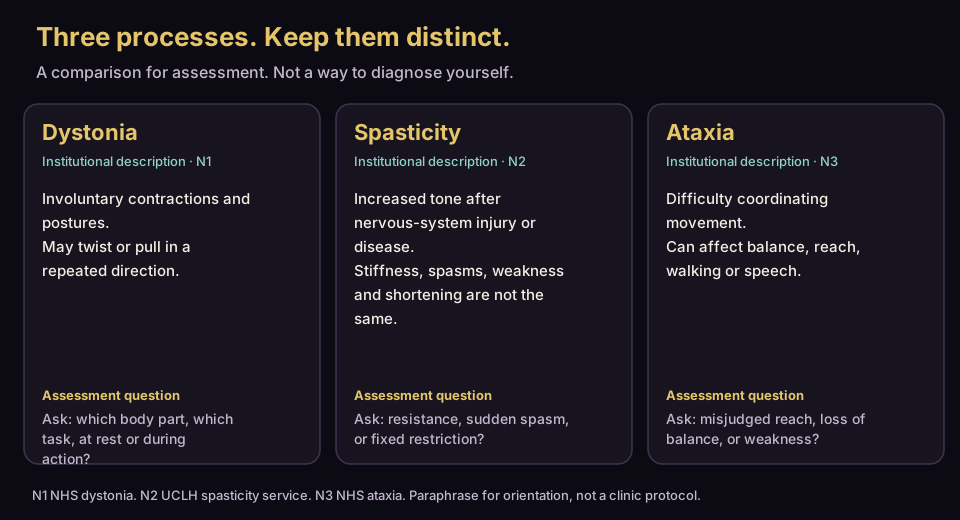
A comparison to prepare for assessment, not a way to diagnose yourself. The three processes stay distinct.Read diagram text
Dystonia (N1): involuntary contractions and postures. Ask which part, which task, rest or action. Spasticity (N2): increased tone after nervous-system injury or disease. Ask whether the problem is resistance, a sudden spasm, or a fixed restriction. Ataxia (N3): difficulty coordinating movement. Ask whether the example is a misjudged reach, loss of balance, or weakness.
Comparison for assessment. Not a self-diagnosis. Not proposed as Matthew's diagnoses.
2 · Possible explanations
Two separate conditions that happen to co-exist, each needing its own treatment.
A shared mechanism in which the same medicine helps both (a hypothesis to test, not assume).
Indirect effects: better organisation, sleep or activity on treatment improving physical symptoms.
Other causes of pain, stiffness or fatigue that should be checked regardless.
Some hereditary movement disorders can include parkinsonism with variable response to levodopa; this is described in case series and reviews, and needs specialist assessment.
Record physical symptoms the way a physiotherapist or neurologist would want them: what moves or hurts, when, for how long, what makes it better or worse, and timing relative to each dose. Short videos with time stamps can help a clinician — share them with the clinician rather than publicly.
5 · Deeper explanation
Dopamine is central to both motivation and movement control; that is why one medicine can plausibly affect both. But "this medicine helped" does not identify why. A response can come from the drug's main effect, from changed sleep or activity, from expectation, or from a second condition. Specialist assessment is what separates these.